190+
countries
50
U.S. state labor law
compliance
1
M+
contractors managed
120
+
local currencies
for contractOR pay


Hire contractors globally without opening entities. Worksuite acts as Agent of Record (AOR) for your independent contractors worldwide — owning classification, contracts, indemnification, and payments on your organization’s behalf.
Worksuite AOR provides a single, compliant path for engaging and paying international contractors and small vendors across 190+ jurisdictions — eliminating fragmented processes and mitigating compliance risk. Expand into new markets without the entity setup.
countries
U.S. state labor law
compliance
contractors managed
local currencies
for contractOR pay
Worksuite's indemnification-backed classification engine evaluates each worker against applicable federal, state, and local legal tests, across all 50 U.S. states and 190+ countries. While classification is confirmed, automated onboarding workflows collect everything required:
No back-and-forth emails. No compliance gaps. Every worker correctly classified and onboarded before the engagement starts.

Worksuite generates a localized, legally compliant contractor agreement tailored to the worker's jurisdiction.
The contract is executed directly between the worker and Worksuite, making Worksuite the legal entity (agent of record) for that engagement. E-sign, countersign, and centralized document storage included.
Your organization continues to manage the work and the worker. Worksuite owns the legal contract relationship — mitigating your risk.
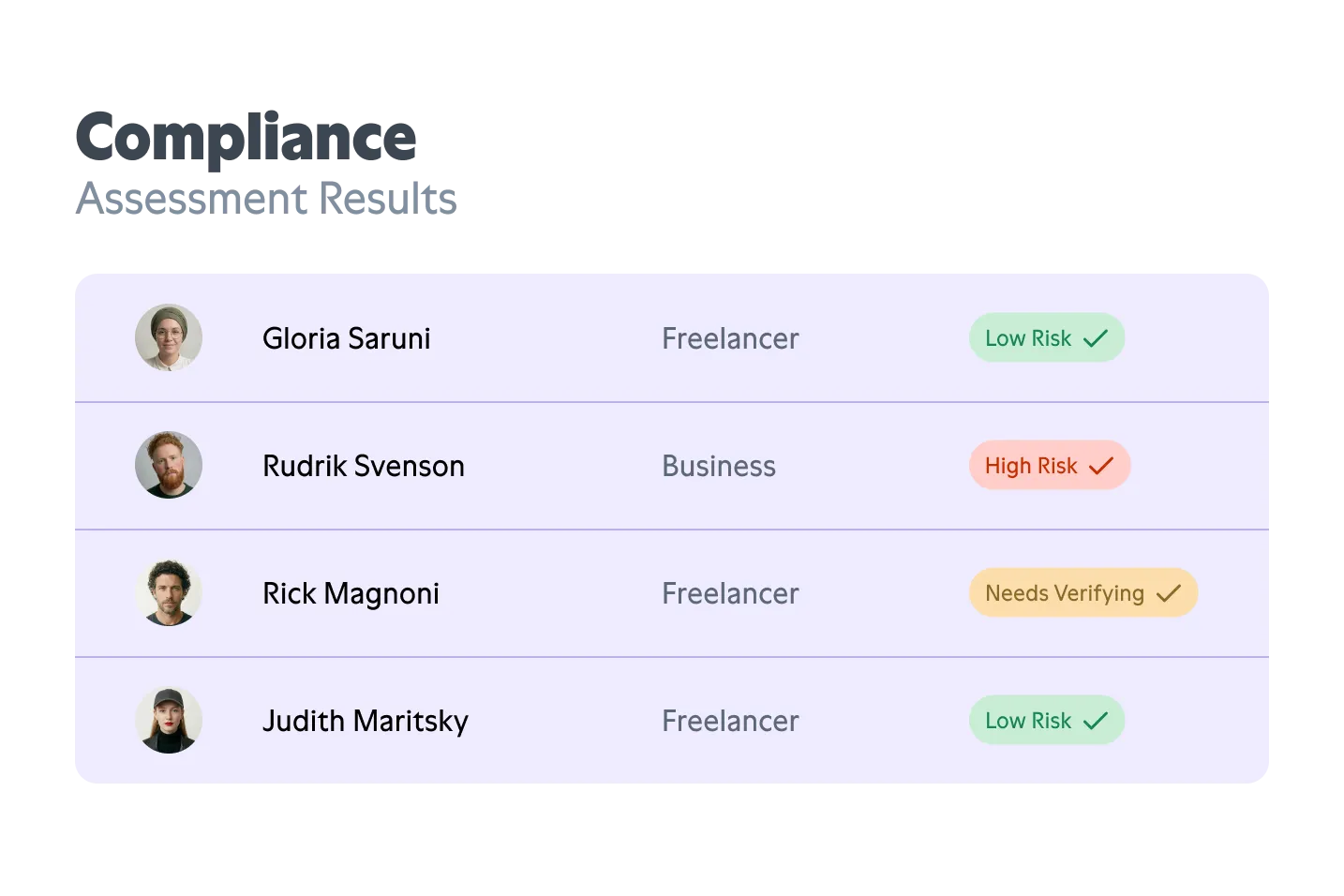
With compliance documented and contract signed, your contractor is cleared to engage. Payment is processed by Worksuite across 190+ countries in 120+ currencies. Tax filing handled. Audit-ready defense files are maintained throughout the engagement lifecycle.
Unlike a standalone AOR service, every engagement record lives inside your unified Worksuite FMS platform, connected to the rest of your contingent workforce program, and visible to Finance, Legal, and Operations in one place.

Worksuite performs worker classification in accordance with federal, state, and local legal guidelines, across all 50 U.S. states and 190+ countries. Every classification decision is backed by human compliance experts and misclassification indemnification, meaning Worksuite assumes responsibility if a classification is ever disputed.
A compliant, jurisdiction-specific contractor agreement is generated and executed directly between the worker and Worksuite — not your organization. Redline and review functions supported. Every contract stored, searchable, and audit-ready in a centralized document repository.
Tax information collected and verified via TIN Matching. Worksuite, as AOR, files all applicable tax forms (1099s and international equivalents), removing that administrative burden from your Finance and Legal teams entirely.
Once contracts are signed and work is approved, Worksuite remits payments directly to contractors in 190+ countries across 120+ currencies. No wire logistics. No AP back-and-forth. Invoices approved by your team, payments processed by ours.
Contractor insurance verified, tracked, and stored within the same central platform. On-demand fractional workers' compensation and general liability coverage available per engagement through our 1099Policy integration, protecting your business at the assignment level.
Every step of the contractor lifecycle, handled compliantly. All in one single point of access. No coordinating between vendors or disjointed systems.

“If you’re looking for a comprehensive platform to help you pay and manage contractors and their contracts with compliance, Worksuite is the best product out there.”

An Agent of Record acts as the administrative intermediary between your company and your independent contractors. The AOR handles compliance, contracts, payments, and tax filing — but the worker remains classified as a 1099 independent contractor, not an employee. An Employer of Record, by contrast, employs the worker directly on your behalf as a W-2 employee, taking on all employer tax obligations, benefits administration, and employment law compliance. The practical distinction: if a worker qualifies as an independent contractor, AOR is the faster, lower-cost path. If the worker doesn't pass IC classification — due to AB5 in California, IR35 in the UK, or the nature of the engagement — EOR handles the employment relationship.
AOR service covers the full administrative layer of a 1099 contractor relationship: IC classification assessment, contract execution under the AOR's legal entity, insurance verification (typically via a product like 1099Policy), compliant payments, W-9 collection, and year-end 1099-NEC filing. The AOR also accepts transfer of risk — meaning your company is no longer the entity of record on the contractor relationship, which shifts misclassification exposure and reduces your direct liability. What AOR does not cover: workers who fail IC classification, employment benefits, or workers' compensation claims arising from employee-type relationships.
The hiring manager initiates the engagement in the platform and invites the worker. The worker completes an IC classification questionnaire and document collection — business entity verification, insurance confirmation, and any jurisdiction-specific requirements. Once the worker passes classification and documentation is complete, the AOR entity executes the contract. From that point, the worker submits invoices, logs time, or delivers against milestones through the platform. The AOR processes payment. At year-end, the AOR issues the 1099-NEC. Extensions, rate amendments, and offboarding are all managed within the existing engagement record.
AOR fees are typically structured as a percentage of contractor payments — commonly in the 2–5% range depending on program volume, average engagement value, and the scope of compliance services included. Flat per-worker monthly fees are an alternative structure for programs with predictable headcount. The fee covers classification review, contract administration, insurance coordination, payment processing, and 1099 filing. For high-volume programs, tiered pricing typically applies. Compare this to agency markup costs — which typically run 30–50% of contractor compensation — and AOR represents a significant reduction in the cost of compliant contractor engagement.
Existing engagements can be extended directly within the platform — no new engagement record required. End date, hours authorized, and rate can be amended on the active record. The practical guidance: if the gap between the original end date and the extension request is short and the nature of the work hasn't changed materially, an extension is the appropriate path. If there has been a significant gap in engagement, or if the scope of work has changed substantially, a new engagement may be warranted — both for clean record-keeping and to ensure the classification assessment reflects the current working relationship.
AOR reporting includes worker name, engagement dates, authorized hours or project scope, PO number, payment amounts processed, and 1099Policy enrollment status. Reports can be pulled on-demand or configured to export on a regular schedule. For programs that run both AOR (1099) and EOR (W-2) workers in the same platform, the reporting separates by worker classification so finance sees a clean view of each population — contractor costs versus employment costs — without manual segmentation.
Under EOR, the EOR entity pays the worker as an employee on a fixed payroll cycle — payroll runs regardless of when your company funds the EOR. Under AOR, contractor payment follows a sequential liability model: the contractor is paid after client funding is received and confirmed by the AOR. This means your payment timing directly affects contractor payment timing. Most AOR programs operate on a 5–7 business day funding-to-disbursement window. If same-day or accelerated contractor payment is a requirement, confirm your program's funding and payment cadence at setup.
Tell us about your contingent workforce program, and we'll show you exactly how Worksuite AOR fits your organization’s compliance requirements, anywhere you operate.