External development stopped being a stopgap a long time ago. Most developers and publishers now send between 30% and 60% of their projects to external partners, and in disciplines like art, localization, QA, and audio it’s closer to 50%.
The operational reality hasn't caught up, though. Engagements overwhelmingly kick off mid-cycle, during Production and Pre-Production (exactly when the schedule is tightest). Onboarding a new partner takes one to three months, and 39% of developers and publishers report it running longer.
That’s because contracts, security reviews, and compliance checks never move as fast as you’d like.
Game outsourcing doesn’t have to be complicated. Below, we cover how studios manage external partners and contractors:
- Engagement models
- IP and confidentiality layer
- Onboarding
- Milestone contracting
- Subcontracting
- Payment
Key Takeaways
- External development is structural. Most studios route a major share of production to outside partners, and the sourcing decision is now a standing operational function.
- The engagement model matters more than the vendor. A service provider studio, individual contractor, and staff-augmented resource carry different compliance, IP, and payment requirements.
- Subcontracting is common enough that knowing who you contracted with isn't the same as knowing who is doing the work.
- Onboarding friction is a buyer-side problem. Developers and publishers carry more of the compliance and process load, which is why their onboarding timelines run longer than their partners'.
What Gaming Studios Outsource (and Why)
External development covers any part of the build handled by an outside service provider:
- Art
- Animation
- Cinematics
- Audio
- Engineering
- Porting
- UX and UI
- Motion capture
- QA
- Localization
The services in heaviest demand are where internal capacity is thinnest. Localization is the single most relied-upon external service, followed by player experience and insights, audio, and engineering. Art remains the most widely offered service across providers, with animation close behind and engineering entering the top three for the first time.
Flexible skill-set ramp-up and ramp-down are the biggest reasons for outsourcing, and cost savings still matter, but two newer drivers now sit near the top:
- Augmenting primary teams (cited by roughly 46% of developers and publishers)
- Lack of internal resources (cited by nearly 40%)
Service providers predicting demand for the year ahead point to the same cluster: cost reduction pressure, team flexibility and scalability, AI and emerging technology capability gaps, and competition for specialized skills.
Ultimately, studios aren't only outsourcing to spend less. They're outsourcing because their current teams don’t have the necessary skills and hiring for them full-time isn't the plan.
Vendor Studio or Individual Contractor?
The first real decision isn't which partner. It's which engagement model (because the compliance and operational requirements change sharply):
- A service provider studio is a business-to-business relationship. You contract with a company, they assign their own people, they manage delivery, and they carry employment responsibility for their staff. Your obligations run to the vendor rather than to the individuals doing the work.
- An individual contractor is a direct engagement with a person. You take on worker classification responsibility, jurisdiction-specific contracting, tax documentation, and payment. The upside is control over exactly who works on the project and a direct relationship you can re-engage.
- Staff augmentation is where a provider supplies named individuals who work under your direction, on your schedule, embedded in your team. The paperwork says vendor services, but the working relationship can look like employment (and that’s what regulators look at).
Roughly 42% of developers and publishers report that their providers subcontract work, and 53% of service providers say they accept subcontracted work.
This means the studio you vetted may not be the studio doing the work.
That's a quality question, a security question, and a compliance question all wrapped up in one, and it's the reason contracts should address subcontracting explicitly rather than leaving it unstated.
Most studios run all three simultaneously. The failure mode is applying one contract template and one compliance process across all of them.
IP, NDAs, and Confidentiality
Unannounced titles, engine code, and pre-release assets are the most sensitive material a studio has, and external development puts them in other people's hands by design. These things need to be right before anyone gets access, though:
- IP assignment has to be unambiguous and has to flow through subcontractors. A clean assignment from your vendor is worth less than it looks if that vendor subcontracted the actual work under weaker terms. Contracts should require that subcontractors are bound by equivalent IP and confidentiality obligations, and that subcontracting is disclosed rather than assumed.
- NDAs need to reach individuals, not only entities. An NDA with a provider company doesn't automatically bind the individual artist who has your unannounced character designs on a personal machine. For engagements where that matters, individual-level agreements are the stronger position.
- Security expectations should be stated rather than presumed. Only about 8% of developers and publishers explicitly expect ISO 27001 from partners, and only around 9% of service providers hold it. Formal certification clearly isn't the industry norm, which makes it more important that your contract specifies the controls you require: asset handling, access management, device policy, and what happens at the end of the engagement.
Milestone Contracting and Payment Gating
Retainer agreements are now the top contract preference on both sides (milestone-based and time and materials are close behind). Most engagements run six to twelve months, and the service provider side has seen a shift toward that longer range.
Milestone contracting is where studios get the most operational control, as long as the contract actually enforces something.
A milestone structure ties payment to accepted deliverables. That aligns incentives and gives you natural checkpoints to catch problems while they're still cheap. Still, a milestone description in a PDF doesn’t really give you control.
The version that works blocks an invoice that exceeds the remaining budget on a statement of work before it reaches finance, rather than surfacing the overage in a reconciliation weeks later.
Two things make that enforcement matter more in game development than in most industries.
- Late-stage scope changes are common. Roughly a fifth of service providers cite late-stage scope, capacity, or timeline changes as a top industry concern. When scope moves, the budget question moves with it, and an unenforced cap now turns into a dispute.
- Payment reliability has become a partner selection factor. Late payment and client solvency are increasingly cited by service providers as reasons to decline work. In a market where provider consolidation means fewer small and mid-sized studios competing for your business, being the client who pays predictably is a massive sourcing advantage.
Cross-Border Payment and Classification
Game development is distributed. Geography is no longer a barrier to partner selection. What hasn't stopped mattering, though, is that every jurisdiction applies its own rules.
- Classification follows the work. An individual contractor is assessed under the law of the country where the work is performed. It doesn’t matter where your studio is headquartered. A contractor who clearly qualifies as independent in the US can default to employee status in Germany, Spain, or the Netherlands.
- Tax documentation comes before the first payment. Domestic contractors submit a W-9. International individuals submit a W-8BEN. Without valid documentation on file, the IRS requires 30% withholding on applicable US-source payments.
- Payment has to land. Local currency, a payout method that functions in that market, and fees that don't erode the provider's margin. For studios working with providers across a dozen countries, running that manually through wires causes delays and friction.
- Contracts need local enforceability. A US contract template used unmodified in Poland or Brazil often fails on both enforceability and classification, and the IP assignment clause is the part you least want tested.
AI Is Now a Contract Term
Developers and publishers have become more cautious about AI in external development pipelines, with the share saying they don't plan to use it nearly doubling year over year. Service providers moved the opposite direction, with more building capability.
The gap is resolved contractually.
Disclosure of when and how AI is used is the top requested policy on both sides. Restrictions on using client data to train models follow closely. Blanket prohibition (which roughly 44% of developers and publishers wanted in 2025) dropped to around 18% in 2026 — this is a shift from broad bans toward specific, clause-level governance.
Permission is the real constraint on deployment. Roughly 54% of service providers report that AI is permitted in only 0 to 9% of their engagements.
How Worksuite Supports External Development Programs
Worksuite handles the contractor and compliance layer of external development, which is the part that adds weeks to manual onboarding.
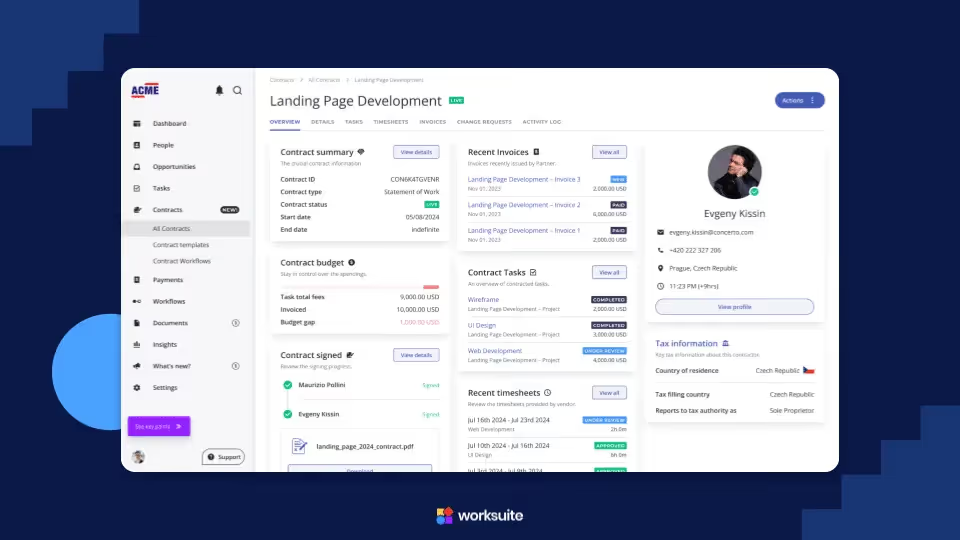
- Contract templates are approved once by legal and issued automatically per engagement type and jurisdiction, including SOW, retainer, time and materials, and framework agreements like NDAs and IP assignments. Statement of work contracts carry budget enforcement, so an invoice that would exceed the remaining milestone budget is blocked before it reaches finance.
- Classification runs against the applicable federal, state, and local tests across all 50 US states and 190+ countries before contracts are signed, backed by indemnification. Onboarding workflows collect tax documentation, NDAs, and IP assignments automatically based on the individual's location and engagement type, which compresses the buyer-side compliance load that makes studio onboarding timelines run long.
- Global Pay processes payments in 190+ countries and 120+ currencies using local payout methods, with payment status visible to both sides.
Worksuite works with studios and publishers including Sumo Digital, Crytek, and Microsoft. For more on the wider practice, see our guide to external game development.
Book a live demo to see how Worksuite manages external development partners and contractors.

FAQ
What is game outsourcing?
Game outsourcing, known in the industry as external development or ExDev, is the practice of developers and publishers engaging outside service providers for part of a game's production. That includes art, animation, cinematics, audio, engineering, porting, UX and UI, QA, and localization. Most studios now route a significant share of production externally.
Should studios contract with a vendor studio or individual contractors?
It depends on the work and the control you need. A service provider studio is a business-to-business relationship where the vendor carries employment responsibility for its staff. Individual contractors give you direct control over who works on the project, but you take on classification, contracting, and payment obligations per jurisdiction. Worksuite handles the individual contractor side, including classification across all 50 US states and 190+ countries.
How do studios protect IP when outsourcing game development?
Through unambiguous IP assignment that flows through to subcontractors, NDAs that bind individuals rather than only entities, and contractually specified security controls. Subcontracting is common enough that the studio you vetted may not be the studio doing the work, so agreements should require disclosure and equivalent obligations downstream.
How do you pay international game development partners?
In local currency, through a method that works in their market, with tax documentation collected before the first payment. Worksuite Global Pay processes payments in 190+ countries and 120+ currencies.