There’s nothing wrong with managing a handful of freelancers from a spreadsheet. That’s a perfectly reasonable approach. But managing hundreds of them across multiple countries, with different compliance requirements and payment currencies — that just doesn’t work at scale.
Freelancer management platforms (or FMS platforms) aim to fix that. These solutions cover everything from full enterprise FMS platforms with global payment infrastructure and indemnification-backed classification to niche marketplaces and lightweight project tools that serve specific use cases.
Below, we’ll cover the best-of-the-best tools in 2026, what each solves, and who should be using them.
Key Takeaways
- Freelancer management platforms (FMS) are built for organizations managing independent contractors. They are not for freelancers managing their own projects.
- The right platform depends on your scale, contractor geography, and whether your primary need is managing existing talent or sourcing new talent.
- Worksuite is the only platform in this category recognized as a Leader in Everest Group's FEMS PEAK Matrix® for two consecutive years, covering the full contractor lifecycle in one connected system.
- Most platforms do some things well but not everything. Know which problem you're solving before committing to a stack.
What Is a Freelancer Management System?
A Freelancer Management System (FMS) is a platform that helps organizations onboard, manage, pay, and stay compliant with their independent contractor and freelancer workforce. Marketplaces help you find new talent and project management tools track tasks, but an FMS manages the full operational relationship between your organization and the contractors you engage.
At a minimum, a solid FMS handles:
- Contractor onboarding and document collection (W-9s, W-8BENs, NDAs, IDs)
- Worker classification (1099 vs. W-2, IC vs. employee across jurisdictions)
- Contract creation, e-signature, and lifecycle management
- Invoice generation, approval workflows, and payment processing
- Tax form generation and filing (1099s and international equivalents)
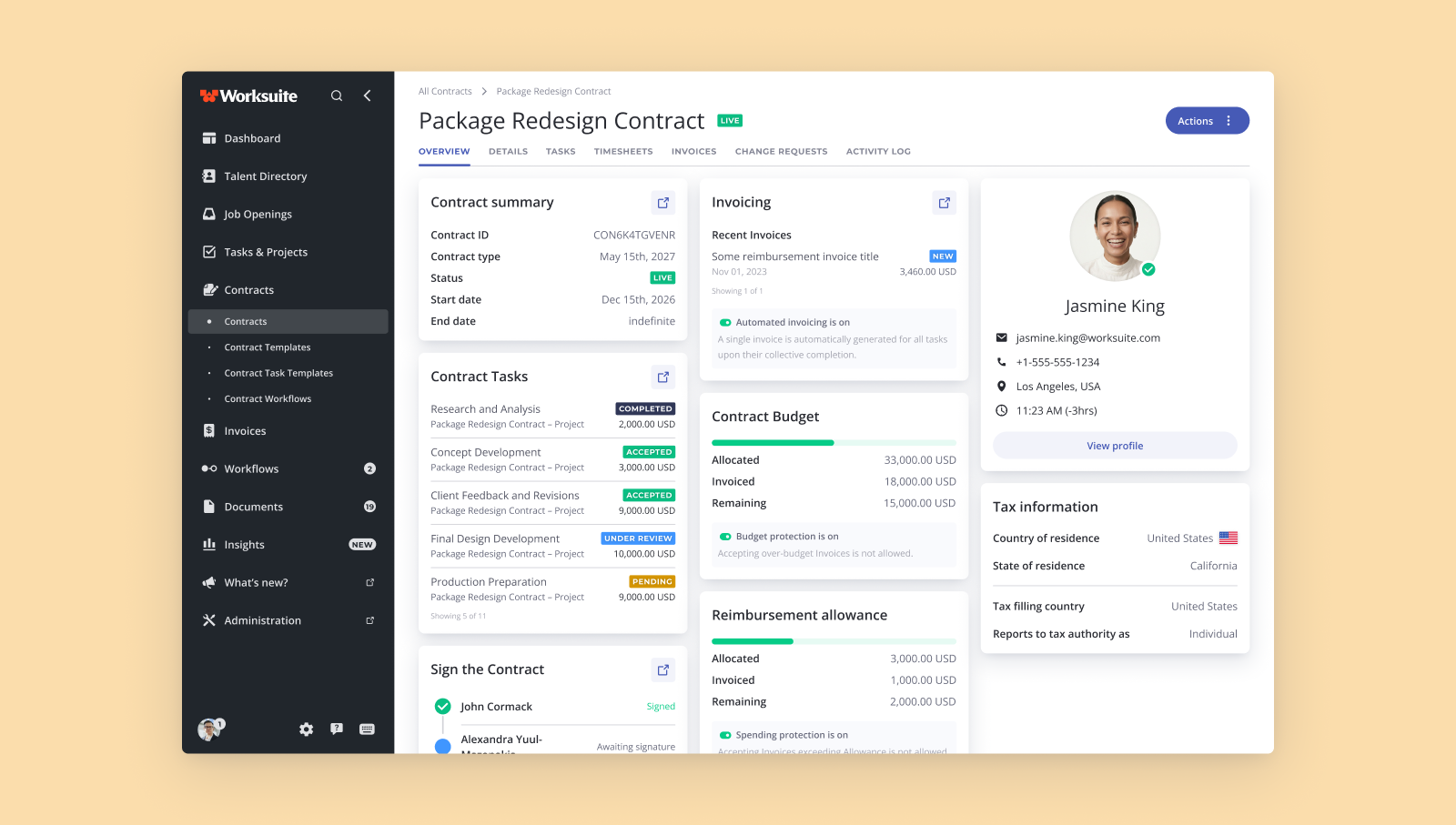
The best ones do all of this inside a single system with compliance built into every step. According to SelectSoftware Reviews, the FMS category has grown as companies increasingly manage freelancers and independent contractors across multiple countries and worker types
And that’s a trend that shows no signs of slowing.
The 7 Best Freelancer Management Platforms in 2026
These platforms cover everything from enterprise programs managing thousands of contractors globally to smaller teams that need marketplace access and basic management tooling. Not every solution is going to be the right fit for your use case. Pay attention to the Best For line on each one.
1. Worksuite
Worksuite is the freelancer management platform purpose-built for organizations with complex, high-volume contingent workforce programs. Worksuite starts from the freelancer contract lifecycle and builds outward. Every step (from onboarding a new contractor to processing their final invoice, to re-engaging them while maintaining spend control) lives in one connected platform.
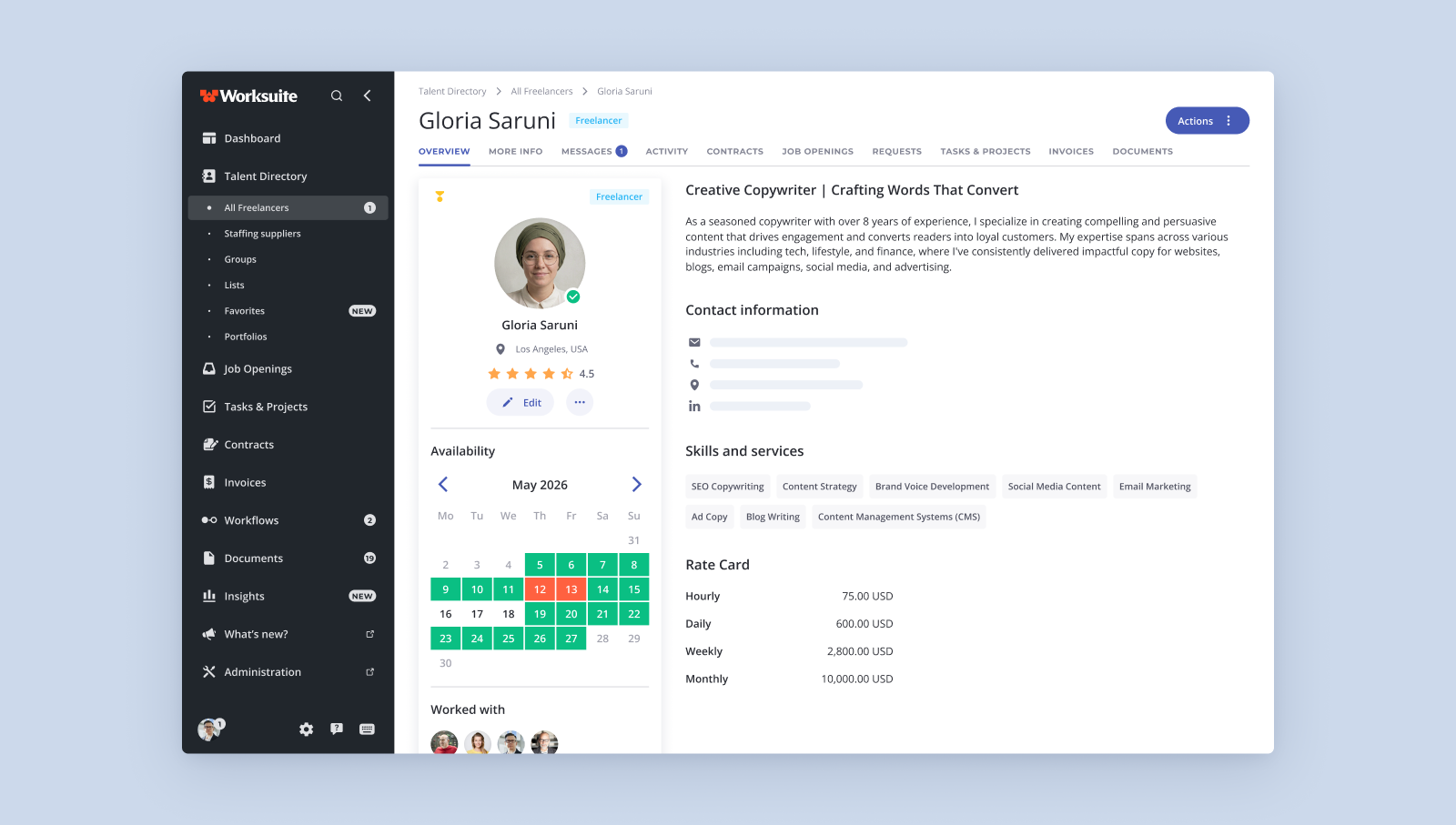
It's the system of record for creative agencies, media companies, live events and production houses, and enterprise brand teams managing contractors globally. Trusted by The Walt Disney Company, Microsoft, Vox Media, Jack Morton, and The Motley Fool. And for the second consecutive year, Worksuite has been recognized as a leader in Everest Group’s Freelancer Engagement and Management Systems (FEMS) PEAK Matrix® Assessment — placing in the top tier across both market impact and vision & capability.
Key Features:
- Automated onboarding workflows with compliance checkpoints per role, location, and entity
- Indemnification-backed contractor classification across all 50 U.S. states and 190+ countries
- Full contract lifecycle management: templates, redlining, e-signature, expiration monitoring, auto-renewal
- Global Pay processing in 190+ countries and 120+ currencies, with 1099 filing handled automatically
- Private talent pool with searchable profiles, 12-week availability forecasting, and project history
- Agent of Record (AOR) services for organizations engaging contractors without entity setup
- Per-gig contractor insurance through a 1099Policy integration
- Integrations with NetSuite, QuickBooks, Salesforce, Slack, Veriff, and 8,000+ apps via Zapier
Best for: Creative agencies, media publishers, live event companies, coaching networks, and any enterprise managing 50 to 5,000+ freelancers across multiple brands and jurisdictions. Worksuite is tailored for complex contingent workforce programs (with specific compliance needs) as they scale globally.
2. TalentDesk
TalentDesk is a freelancer and vendor management platform with coverage in 150+ countries. It’s built for companies managing both independent contractors and agency-sourced talent. Its vendor management feature connects contractors to their respective agencies for better oversight.
AOR and EOR services are available through TalentDesk for compliance-heavy engagements. The built-in talent marketplace is smaller than competitors like YunoJuno (around 3,000 freelancers vs. 100,000+), which makes it better as a management platform for existing talent than a sourcing tool for new talent.
Key Features:
- Contractor and vendor management in one platform
- AOR and EOR services for compliant global hiring
- Automated consolidated invoicing — one invoice to approve for multiple contractors
- Project tracking with real-time dashboard
- Integrations with Xero, NetSuite, and major accounting tools
Best for: Organizations managing a mix of direct freelancers and agency-sourced contractors who want clear visibility into both populations in one platform.
3. YunoJuno
YunoJuno is a freelancer management platform built primarily for the UK and European creative, marketing, and media industries. Its combination of a vetted talent marketplace (100,000+ freelancers) and IR35-aware contractor management makes it a strong option for UK-headquartered programs that need both sourcing and compliance in one place.
Global coverage is considerably thinner outside the UK and Europe. YunoJuno's revenue model is payroll-volume-dependent (it earns on payroll processing), which creates an inherent incentive toward employment arrangements over independent classification.
Key Features:
- 100,000+ vetted UK and European freelancers in the marketplace
- Built-in IR35 status determination and compliance support
- Human sourcing support available at no extra cost
- Automated contracts and real-time updates on UK/EU legal requirements
- Flexible brief posting: open or unlisted for sensitive projects
Best for: UK and European creative, marketing, and media companies that need marketplace sourcing combined with IR35-aware contractor management.
4. Worksome
Worksome is a contractor management platform built for compliance-heavy programs in Europe with a revenue model built around payroll processing. Its worker classification is solid for European frameworks including IR35 and the EU Posted Workers Directive, and it offers misclassification indemnification.
Like YunoJuno, the payroll-centric revenue model creates a structural incentive toward employment arrangements over independent classification. For programs that genuinely need payroll processing for European contractors, that's fine. For programs looking for unbiased AOR guidance, it's worth keeping in mind.
Key Features:
- Automated worker classification with jurisdiction-specific rules
- Misclassification indemnification coverage
- Internal talent pool plus external marketplace sourcing
- Multi-currency payments
- IR35 and EU compliance support
Best for: EU-headquartered programs that need compliance infrastructure for European contractor workforces, particularly those already operating within payroll frameworks.
5. Upwork Enterprise
Upwork Enterprise adds compliance, reporting, and consolidated invoicing on top of Upwork's marketplace of 57 million+ freelancers. It's a good choice for organizations that rely heavily on Upwork as a sourcing channel and want better visibility and control over those engagements at the enterprise level.
Classification support is limited, and the platform is structurally optimized for marketplace sourcing rather than managing an existing contractor population. Transaction fees add up at scale, too.
Key Features:
- Access to Upwork's marketplace of 57 million+ freelancers
- Enterprise compliance assistance and dedicated program managers
- Consolidated invoicing and spend visibility
- Freelancer rating and review system
- Any Hire option for bringing existing contractors into the Upwork system
Best for: Organizations that source heavily from Upwork and want enterprise-grade management, compliance support, and spend visibility over those engagements.
6. Fiverr Enterprise
Fiverr Enterprise connects internal contractor management tools with Fiverr's marketplace, adding compliance, onboarding, and visibility features on top of Fiverr's sourcing network. For companies that source heavily from Fiverr, the integrated approach gives operational control that the standard marketplace doesn't.
Fiverr Enterprise is architected around Fiverr's talent pool. Organizations managing existing contractor relationships outside that marketplace won’t find it a good fit.
Key Features:
- Contractor onboarding, classification, and payments
- Direct access to Fiverr's marketplace for sourcing
- Budget tracking and spend visibility by department
- Automated compliance checks and document collection
- Integrations with HR and finance systems
Best for: Organizations that source contractors primarily through Fiverr and want enterprise-level compliance and management over those engagements.
7. Toptal
Toptal is a premium freelance talent network that pre-vets every candidate and only accepts the top applicants into its network. It's not an FMS in the traditional sense, though. There's no onboarding workflow, classification engine, or payment infrastructure built for enterprise contractor programs. Instead, it surfaces high-quality, pre-screened talent fast with a quality guarantee and a no-charge replacement policy if a match doesn't work out.
For organizations with specialized hiring needs and a premium on talent quality over operational management features, Toptal can help. For organizations that need an operational platform to manage an existing contractor population at scale, it doesn't.
Key Features:
- Pre-vetted freelancers across development, design, finance, and more
- Matched candidates delivered in days
- Trial period with every new hire before billing begins
- Quality guarantee with no-charge replacement
- Flexible on-site or remote arrangements
Best for: Companies that prioritize talent quality over management features and need to place specialized, senior-level freelancers quickly.
Private FMS vs. Public Marketplace: What's the Difference?
Our list above covers a couple of different types of solutions. There are private platforms you run yourself, and then there are marketplaces you plug into. They’re different products that solve different problems.
- A public marketplace gives you access to a pool of talent the vendor assembled.
- A private FMS gives you infrastructure to build and own a pool of your own.
One is used to find (and rent) people, while the other keeps them.
Where Marketplaces Win
Marketplaces only really work for cold sourcing. If you need a Rust developer with satellite telemetry experience and nobody in your network fits, a marketplace with millions of profiles will typically beat your private pool.
Discovery is what they're built for, and a private network is not a discovery engine.
They make sense for one-off engagements, unpredictable or seasonal needs, and organizations early enough in building a contractor program that they don't yet have relationships worth systematizing.
Still, it’s not a perfect platform solution:
- The relationship isn't yours. The marketplace owns the connection. Ratings, work history, and communication live in their system, and your access to that contractor depends on your continued relationship with the platform.
- Your talent is one search away from your competitor. A freelancer who does excellent work for you is visible on the same marketplace to everyone else looking for that skill. In a private pool, they aren't.
- You pay to re-find the same person. Marketplace transaction fees typically run 10 to 20% per engagement. Re-engaging someone you've already worked with costs the same as finding them the first time.
- Compliance is generic. A marketplace applies one process to everyone. A private FMS routes W-9s or W-8BENs based on the contractor's location, applies the classification test relevant to their jurisdiction, and enforces role-specific credentials like certifications or insurance before work starts.
- The experience is theirs. Contractors onboard into the marketplace's brand and UX. With a white-labeled private network, they're onboarding into yours, which matters when you're competing for the same talent everyone else wants.
When to Go with a Private FMS
Every engagement in a private pool adds data you keep:
- Skills verified
- Rate history
- Internal ratings
- Compliance status
- Availability
That record lasts even when a resource manager leaves, and it makes each subsequent hire faster. For example, Aspia grew from 180 contractors to more than 5,000 in four years and now delivers a vetted shortlist in about thirty minutes.
You can also grow a private network using channels you already own. Jack Morton runs a talent signup on their careers page wired straight into onboarding workflows, so interested freelancers raise their hand under the agency's brand and arrive vetted (without anyone manually routing them).
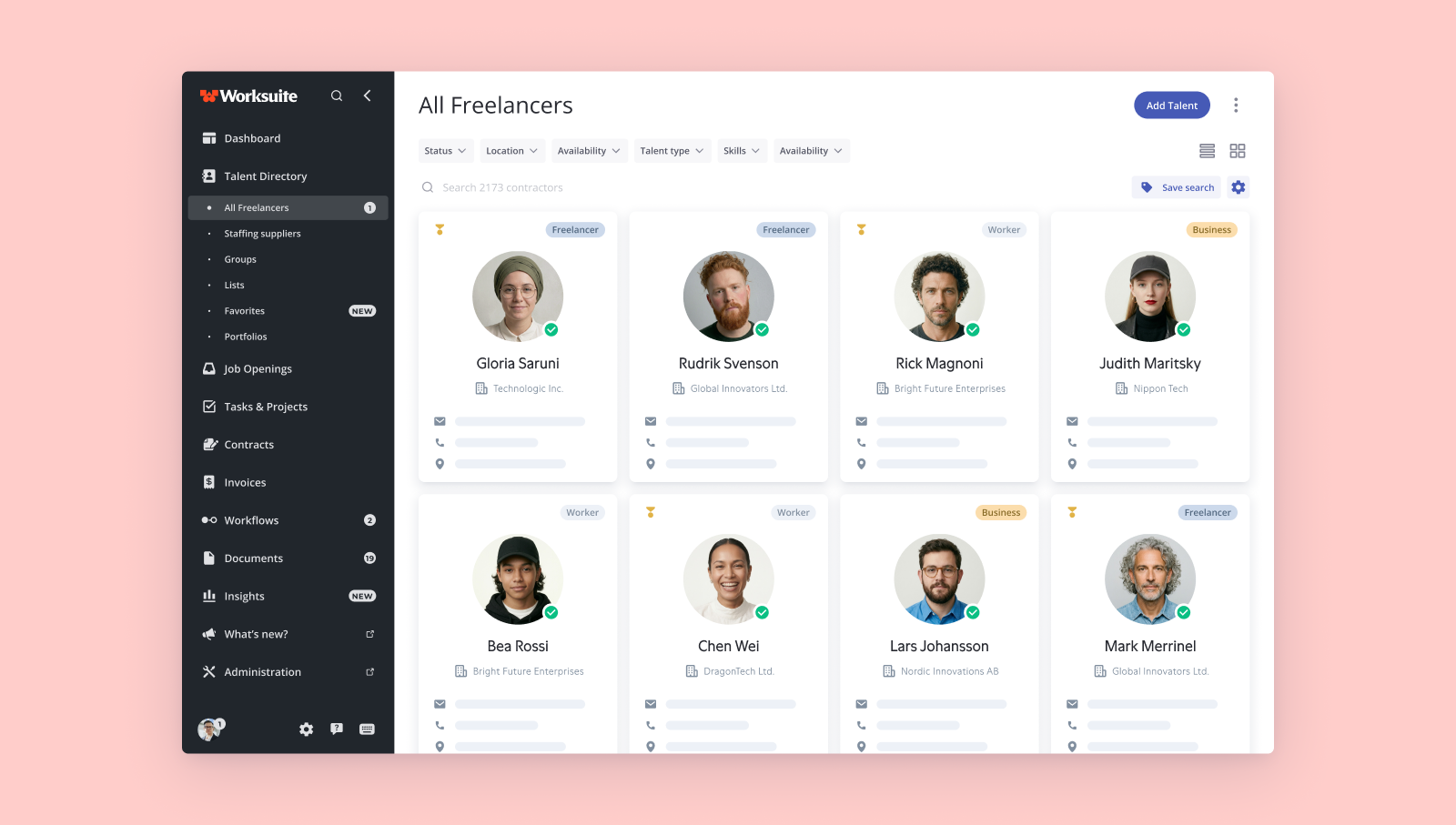
Ultimately, most mature programs use a private FMS and public marketplaces.
Use a marketplace to find talent you don't have. Use a private FMS to keep the talent you've found, so you stop paying to re-find the same person every time a project lands.
The mistake is treating a marketplace as your system of record, because the moment you do, your contractor relationships become something you rent rather than something you own.
How to Choose the Right Freelancer Management Platform
The biggest mistake teams make when evaluating platforms is prioritizing features over fit. A system with every capability on paper still fails if it wasn't built for your contractor type, industry, or compliance environment.
Here’s what to prioritize:
- Volume and growth trajectory. A team managing 15 contractors has different needs than one managing 1,500. Most platforms scale, but the configuration complexity and support quality vary enormously.
- Geography. The moment you're paying contractors in two or more countries, classification rules diverge, tax forms differ, and currency logistics matter. Check whether the platform supports the specific countries your contractors are based in.
- Sourcing vs. management. Some platforms are built to help you find new contractors. Others are built to manage the ones you already have. Most enterprise programs need the latter, but many platforms lead with marketplace access. Know which problem you're solving.
- Compliance depth. Classification support ranges from a basic questionnaire to indemnification-backed decisions with human compliance review. The difference between those two options is a paper trail and real protection.
- Unbiased guidance. Platforms with payroll-volume revenue models have a financial incentive to recommend employment arrangements over independent contractor classification. Worksuite has no such incentive — its consumption-based pricing model (a percentage of payment volume) is aligned with your program.
If you're managing freelancers and independent contractors at any real scale, you know that spreadsheets and emails don't cut it. Worksuite is the best freelancer management platforms for handling everything in one place: onboarding, compliance, contracts, payments, and the visibility your teams need.
Book a live demo and see how it works for your industry and program.

FAQ
What's the difference between a freelancer management system and a talent marketplace?
A talent marketplace (Upwork, Fiverr, Toptal) helps you find new freelancers. A freelancer management system helps you manage the contractors you already have: onboarding, classification, contracts, payments, compliance. Most enterprise programs need FMS capabilities. Some marketplaces have added FMS features on top, but they were built from the sourcing side out, which affects depth and configurability.
Do I need an FMS if I only have a handful of contractors?
Probably not. A well-organized spreadsheet and a DocuSign account can cover the basics. The case for a dedicated platform gets stronger as volume grows, geographies multiply, or compliance requirements get more complex.
What is the Everest Group FEMS PEAK Matrix?
The Freelancer Engagement and Management Systems (FEMS) PEAK Matrix® is an independent assessment by Everest Group that evaluates FMS providers across two dimensions: market impact and vision & capability. It evaluates providers on platform functionality, client adoption, global reach, and product maturity. Worksuite has been recognized as a Leader for two consecutive years (2025 and 2026).
What's the difference between an FMS and a VMS?
A Vendor Management System (VMS) is procurement software built to manage staffing agency relationships and supplier spend. An FMS manages direct relationships with individual independent contractors” onboarding, classification, contracts, and payments. The buyers and workflows are different. Most enterprise programs with both employees and contractors need FMS capabilities for the contractor side.

.avif)