
Most remote management advice assumes your whole team is salaried, in the same country, and working the same hours. That exact team rarely exists anymore.
The real remote teams today are a mix. You have a few full-time employees, a handful of contractors, a freelancer in another timezone who joins for the parts of the project that need her. Managing that group well takes more than the generalized advice you've read a hundred times.
It takes knowing what you can ask of whom, keeping the work visible without hovering, and running the compliance side so it doesn't become a problem. Fortunately, you can make it all happen with the right know-how.
Key Takeaways
- The modern-day remote teams are blended with employees and contractors on the same projects.
- Manage outcomes instead of hours. With contractors, that’s more than a management style preference, since directing their schedule and methods can jeopardize their classification.
- Remote work removes the information you used to absorb passively. Good management replaces it with systems that surface the work on purpose without tipping into surveillance.
- Contractors can be part of the team culture, but invite rather than require, and keep the compliance layer (classification, onboarding, payments) running so it doesn't turn into an audit later.
What Changes When Your Team Is Remote
Remote work isn’t necessarily new, but teams are still trying to figure out how best to work together.
Ultimately, the management fundamentals don't change. Clear expectations, good feedback, trust. That’s standard.
What changes is that remote work removes the ambient information you used to get for free.
In an office you could tell someone was stuck by the look on their face. You overheard the context of a decision without anyone briefing you. You knew who was overloaded because you saw them stay late.
Remote strips all of that out.
If you want to know how someone's doing or where a project stands, you have to build a way to see it on purpose, because it won't reach you by accident anymore. That's the job of managing remotely. Replacing the information you used to absorb passively with systems that surface it deliberately (without turning those systems into surveillance).
And that’s all easier said than done.
How to Manage Remote Teams (the Right Way)
There’s no one-size-fits-all approach to managing remote teams. One standardized process is just a fast track to jamming square pegs into circle holes. Instead, you just need to know the fundamentals and apply them appropriately. When you do that, you get a custom-made remote management process that works for your specific team.
1. Manage the Work (Forget the Hours)
The fastest way to lose a good remote team is to manage like you can see their screens. Tracking activity, demanding instant replies, watching for the green online dot. It signals distrust, and it optimizes for looking busy instead of doing good work.
Manage outcomes instead. Define what needs to get done, by when, to what standard, and let people figure out how. A developer who does her best work at 6am and a writer who hits his stride after dinner will both outperform a rigid 9-to-5 if you let them.
What you lose in synchronised hours you gain in output and retention.
This matters twice as much when your team includes contractors, and the reason goes beyond management preference. Legally, you can't direct a contractor's hours and methods the way you can an employee's. Tell a contractor exactly when to work, require them at every meeting, and manage their day-to-day process, and you've started blurring the line between contractor and employee.
Now you’ve got a classification problem.
Outcome-based management does double duty here. It's better for morale, and for contractors, it's how you stay compliant. Everyone wins.
2. Communicate on Purpose
Remote teams drown in the wrong communication and starve for the right kind. Endless Slack pings, too many status meetings, and yet nobody's sure what was actually decided or where to find it later.
Default to writing things down:
- Decisions
- Context
- Reasoning
- Discussion
- Alternatives
- Contingencies
You want all of it in a place people can find without asking. Async-first communication lets a team spread across timezones stay in sync without everyone being online at once, and it creates a record so the person who joins the project in week three isn't starting from zero.
Save real-time meetings for the things that genuinely need them: working through a hard problem, a conversation that would take forty Slack messages, anything with emotional weight.
A status update is not one of those things. It's just a document.
If your team spans timezones, protect a few hours of overlap where everyone's reachable at once, and be real about which meetings require live attendance. For contractors especially, providing recommended recordings is usually the better call over mandatory attendance.
3. Keep the Whole Team Visible in One Place
You can't manage what you can't see, and on a blended team the seeing gets harder. Employees live in your HR system. Contractors live in someone's inbox, a spreadsheet, and three separate invoicing threads. Nobody has a single view of who's working on what, what it's costing, or when a contract's about to lapse.
That fragmentation is where remote teams lose the thread.
Pull it together. Whatever system you use, you want one place that shows the full picture of your workforce:
- Who's engaged
- In what capacity
- On what project
- At what cost
- With what still outstanding
For the employee side, that's your HRIS. For the contractor side, that's where a freelancer management system earns can help, giving you the same visibility into contractors that you already have into employees.
4. Build Culture That Includes Contractors (Carefully)
Remote culture doesn't happen in hallways, so you have to make it on purpose. That might be through things like virtual coffees, a channel that isn't about work, acknowledging good work in front of the team.
None of it's complicated, but it takes intention that in-person teams never really had to muster.
Contractors make this slightly tricky, though. You want them to feel like part of the team, because engaged people do better work and stick around. But you can't require a contractor to attend the culture stuff the way you might an employee. Mandating a contractor's attendance at team events is the kind of control that muddies their classification.
The right move is to invite instead of require. Make contractors welcome at the team lunch, the celebration, the non-work channel, and let them opt in. The ones who feel valued will show up and bring their best.
5. Run the Compliance Layer So It Doesn't Run You
Managing a blended remote team means managing compliance. And if you ignore it, it doesn't go away. It just waits (and usually gets worse).
Every contractor on your team needs to be a contractor under the law that applies to them, which is the IRS's three-category common law test federally and stricter standards like California's ABC test in some states. That classification isn't a one-time check, either. A contractor who started on a defined project but has drifted into working full-time, exclusively for you, on your schedule, may have become an employee in the eyes of a regulator even if nothing changed on paper.
Then there's the paperwork that has to be right before anyone's paid:
- A signed agreement
- Tax forms (a W-9 for domestic contractors, or a W-8BEN for individual foreign contractors and a W-8BEN-E for foreign business entities)
- Payment set up in the right currency
Miss those and you get a scramble at tax time, or a withholding problem you didn't see coming.
You don't have to run all of this by hand, either. The classification, onboarding documents, contracts, and global payments can all run through one system that keeps the records straight and flags problems.
Managed well, the compliance layer becomes something you check rather than something you firefight.
How Worksuite Helps You Manage Remote Teams
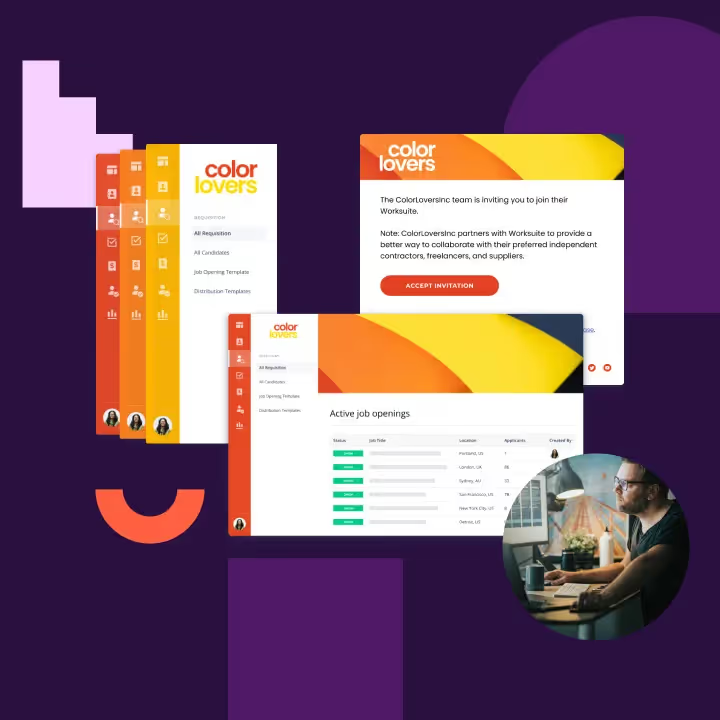
Worksuite Contractor of Record (COR) and Freelancer Management System (FMS) handle the contractor side of a blended remote team, which is usually the side that generates the admin. It classifies workers against the tests that apply in their jurisdiction, runs onboarding so the right documents get collected before work starts, and pays contractors in 190+ countries and 120+ currencies with 1099 filing handled for you.
It gives you one view of your whole contractor workforce: who's engaged, on what, at what cost, so the contractor half of your team is as visible and managed as the employee half. And with Contingent EOR, the same platform now covers employees in countries where you don't have an entity, keeping your full remote team in one place.
Hiring employees where you don't have an entity? Worksuite Contingent EOR routes each hire to a network of 1,200+ vetted in-country providers who act as the legal employer, managed in the same platform as the rest of your contingent workforce.
Book a live demo to see how Worksuite manages the contractor side of your remote team.

FAQ
What's the biggest mistake managers make with remote teams?
Managing hours instead of outcomes. Watching for activity, demanding instant replies, and treating time online as a proxy for productivity signals distrust and rewards the wrong behaviour. Define what good work looks like and when it's due, then let people deliver it their way. With contractors, outcome-based management is also a compliance requirement, since directing their hours and methods can jeopardize their classification.
How do you manage a team across different timezones?
Lead with async communication and written records so work doesn't stall waiting for someone to come online. Protect a small window of overlap hours where the whole team is reachable at once for the conversations that need to happen live. Keep genuinely synchronous meetings rare and make most of them optional with recordings for anyone who can't attend.
How is managing remote contractors different from managing remote employees?
You can direct an employee's hours, methods, and day-to-day work. You can't do the same with a contractor without risking their classification. Contractors should be managed to outcomes and deliverables, invited rather than required for meetings and culture events, and engaged in a way that keeps the relationship genuinely independent.
How do you keep a blended remote team visible?
Consolidate. Employees live in your HR system, but contractors often scatter across email, spreadsheets, and invoicing tools, which leaves you without a single view of your workforce. A freelancer management system gives you visibility into contractors, who's engaged, on what project, and at what cost.
Do remote contractors need different onboarding than employees?
Yes. Employees need tax withholding forms, I-9 verification, and benefits enrollment. Contractors need a signed agreement, a W-9 (or a W-8BEN or W-8BEN-E for international contractors), and payment setup, with no tax withholding. Running a contractor through employee onboarding, or the reverse, either skips required steps or adds ones that don't apply. Keep the two paths separate.


%20vs.%20Freelance%20Management%20System%20(FMS)%20(1).avif)