The global freelance market has changed more in the past three years than in the decade before it. Rates in some categories have fallen under AI pressure while demand in others has climbed sharply. Regulatory ground is shifting under several major markets at once. And the countries that dominated on volume alone no longer dominate on value.
This is an updated look at where the freelance talent is in 2026, what each market is strong at, and what you need to get right to engage people there compliantly.
Key Takeaways
- The US and UK are two of the largest and most sophisticated freelance markets, but both are splitting internally between AI-exposed commodity work and AI-adjacent specialist work.
- Five of the ten markets below have a live regulatory development in 2026.
- Country choice is a compliance decision as much as a cost one. Each market applies its own worker classification rules, and a US contractor agreement rarely holds up abroad.
- Worksuite engages and pays contractors compliantly in 190+ countries and 120+ currencies, with classification handled per jurisdiction before work starts.
Why Hire Freelancers Internationally?
If you’re located in the U.S., you probably know that there are millions of freelancers available for hire within the country. However, finding quality talent shouldn’t have to be restricted to your borders.
The old logic was hire offshore, pay less. That still works in some categories, but the gap has changed in the skills most companies need. Senior engineers in Poland or Ukraine demand rates approaching Western European levels — that's because demand for them is global. AI has compressed pricing at the commodity end almost everywhere, so the arbitrage that used to exist on basic writing or data work has largely evaporated.
The biggest reason to hire internationally in 2026 is access. Some markets have deep concentrations of specific skills, and if you restrict hiring to your own country you're competing with everyone else for a smaller pool. The more important questions are:
- Which market has the skill you need?
- Can you afford that market's rates?
- Can you engage someone there without creating a compliance problem?
For country-specific hiring rules, tax obligations, and classification tests, see Worksuite's Country Explorer.
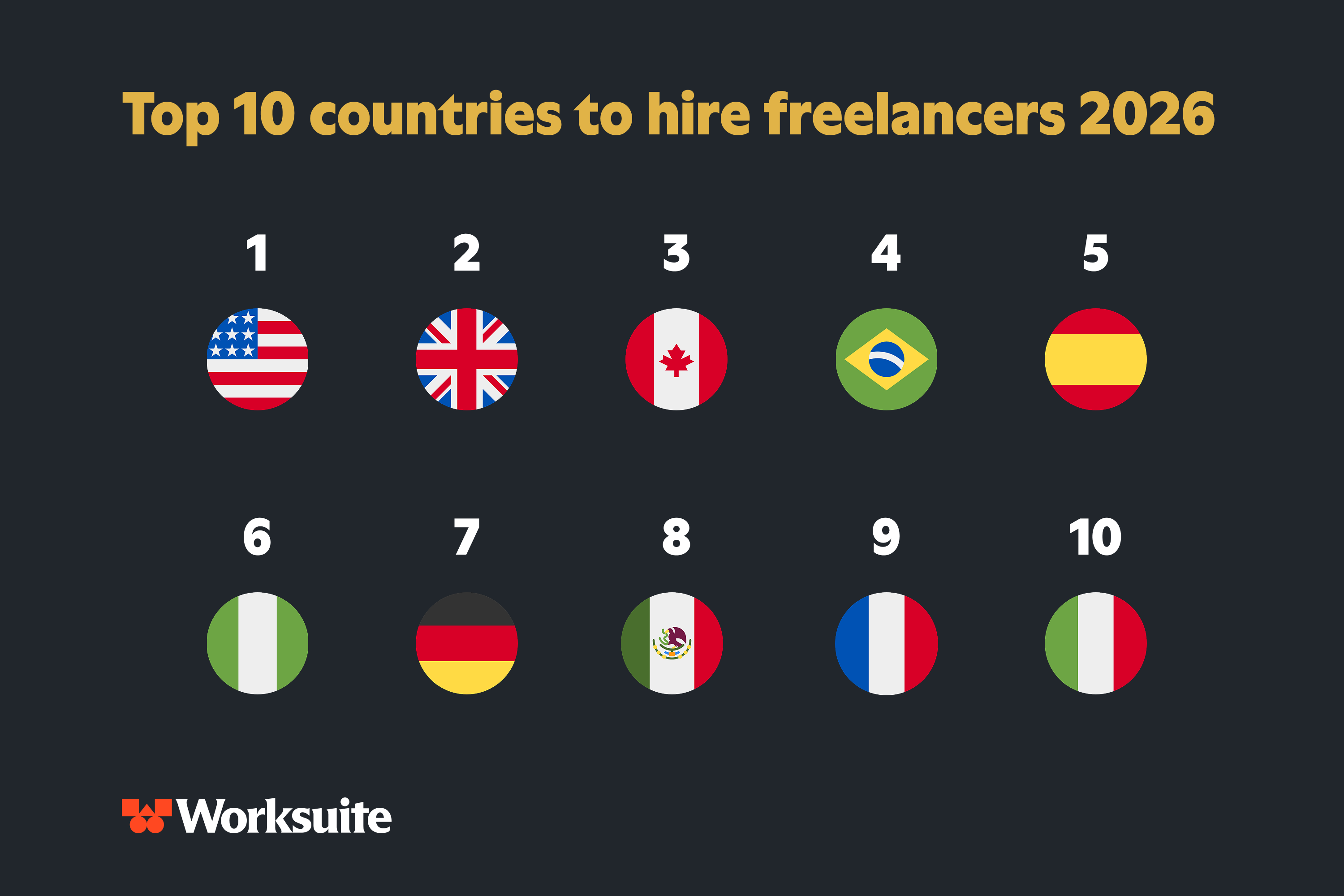
The 10 Best Countries to Hire Freelancers in 2026
1. United States
US freelancing split into two markets in 2026.
- AI-adjacent skill demand on Upwork grew 109% year over year, with prompt engineering and LLM integration now commanding $100 to $300 per hour, and 77% of business leaders report AI is increasing their need for specialized fractional talent. Generalist writing and admin work sit on the opposite side of that split (where AI exposure is highest and rates are falling).
- Live events and production can't be offshored. Global experiential marketing spend hit $138.9 billion in 2025 and is projected to grow 10.9% in 2026 with freelancers already about 40% of the events workforce.
That work is governed state by state:
- California's AB5 bars film and TV crew from contractor status outright
- Georgia offers a $25,000 bonus for 50%-plus local crew
- Illinois ties a 35% credit to resident labor.
Practical implication: A production moving between states in 2026 is solving cost, classification exposure, and tax-credit eligibility at the same time. That’s a lot. The correct engagement model for the identical rigger role changes at the state line. Programs running across multiple states need classification decided per engagement and per jurisdiction instead of a one-size-fits-all company policy.
2. United Kingdom
Things are changing in the UK market, too.
Outside-IR35 contractors command roughly a 40% day-rate premium over inside-IR35 equivalents, £550 to £700 against £400 to £500. Add AI fluency on top and the gap gets even wider.
Regulatory watch: IR35 small company thresholds rose in April 2026 with:
- Turnover moving from £10.2M to £15M
- The balance sheet test from £5.1M to £7.5M
- Headcount stays at 50
Some organizations moved out of scope, changing the status determination duty mid-relationship.
There’s precedent, too. HMRC won against three BBC presenters who owed £920,000 in back taxes, while ITV's Lorraine Kelly and Kaye Adams won nearly identical cases. The deciding factors were:
- Right of substitution
- Degree of control
- Mutuality of obligation
That pattern (repeat engagement with one client and no genuine substitution) applies equally to an embedded events freelancer and a journalist writing for a single masthead.
Practical implication: Your best UK contractors are usually your highest IR35 exposure, which is an uncomfortable inversion of how most managers think about their talent. The freelancer you rely on most ( who's been with you longest and whom nobody would accept a substitute for) matches the fact pattern that lost the BBC case. Agency networks need visibility across entities because a contractor working for three subsidiaries of the same holding company raises the same mutuality-of-obligation question that departmental spreadsheets will never surface.
3. Canada
Canada is the safest market on this list to formalize a contractor program.
The CRA is actively tightening its degree of control analysis on contractor relationships, and gig platforms are now required to report worker income directly to the agency. Canadian freelancers report declining financial satisfaction despite higher headline rates — that’s more of a maturing market rather than a booming one.
The CRA's control test rewards companies managing contractor relationships through documented, consistent processes rather than informal ad hoc engagement. Steady growth plus regulatory attention makes the case for building it properly from day one.
Canada also draws on one of the world's most educated talent pools with a large STEM graduate population and established technology hubs supporting software engineering, product design, and professional services.
Practical implication: Build the classification and documentation layer before you scale. Retrofitting under CRA scrutiny costs considerably more than getting it right from the get-go.
4. Brazil
Brazil's contractor misclassification risk went from dormant to active in June 2026.
The Supreme Court (STF) lifted the nationwide stay that had frozen all "pejotização" lawsuits — this means misclassification litigation is now resuming in labor courts across the country. Theme 1389 (the case that will eventually set a binding national standard on when a contractor relationship is actually disguised employment) has not been decided on the merits, and no ruling date is confirmed.
The uncertainty in 2026 is more active. Brazil's 25 million-plus self-employed workers now operate in a market with rising litigation risk and no settled national standard.
Regulatory watch: Don't read Brazil as safe to hire now with clarity coming soon. Cases are moving again and the core question remains open.
Practical implication: If you're engaging Brazilian contractors, the structure of the relationship matters more than it did twelve months ago, and documentation of genuine independence is what you'd rely on if a claim surfaces.
5. Spain
Spain's government proposed raising autónomo social security contributions for 2026 through 2028 by €11 to €206 per month depending on income bracket, then abandoned the plan entirely after backlash from ATA (the country's largest freelancer association).
Rates are frozen at 2025 levels for now. Autónomo registration sits at a record 3.42 million, roughly 15.95% of the employed population, though growth is decelerating.
Spain's freelance workforce spans a diverse range of specialisms, helped by a large population of digital nomads who relocated there. You can find a healthy supply of work for:
- Data analytics
- Software development
- Cybersecurity
- Content work
Regulatory watch: The freeze is a temporary reprieve. The pressure to fund Spain's pension system through self-employed contributions has only been deferred.
Practical implication: If you're locking in longer-term rates with Spanish contractors, price in the possibility that their cost base rises before the contract ends. A rate that works today might not survive the next budget cycle.
6. Nigeria
The reason to look at Nigeria in 2026 is a demand-side shift.
Nigerian startups raised roughly $58 million across five companies in May 2026 alone, but investors are now pushing hard for profitability over growth. This means those companies are outsourcing more instead of hiring full-time.
The macro supports it. Nigeria's ICT sector reached 11.31% of real GDP in Q1 2026, up from 10.59% a year earlier, and the country ranks sixth globally in the 2026 Global Outsourcing Talent Index, ahead of Kenya and Egypt.
Two biggest strengths:
- Software engineering, where Nigeria has Africa's largest developer population inside a $15.3 billion tech ecosystem.
- AI training and data annotation, a sector growing roughly 28% annually.
Practical implication: Treat Nigeria as a two-sided market.
7. Germany
Germany's Freiberufler visa has quietly become a talent acquisition channel in its own right.
Indian applications for the freelance visa grew 35% year over year, driven by demand in IT, design, and consulting. That's the profile most contingent workforce programs are trying to source.
Average freelance rates sit around €103 per hour in 2026.
For the first time since the freelancermap survey began, rates didn't rise year over year even as hours worked increased, which reads as a soft-demand signal rather than a booming market.
Germany also applies one of the EU's stricter approaches to contractor classification, and its Scheinselbständigkeit rules treat economic dependence on a single client as a serious risk factor.
Practical implication: Companies building distributed technical programs in the DACH region will increasingly encounter freelancers already established in-country as visa holders rather than people needing sponsorship. That's a much lower-friction hiring path.
8. Mexico
There is no Mexican digital nomad visa. Remote workers and freelancers use the Temporary Resident Visa via financial solvency. This requires roughly $4,300 to $4,500 per month in income or approximately $73,000 to $75,000 in savings over twelve months.
Regulatory watch: REPSE registration is not a formality. Since Mexico's 2021 outsourcing reform, any company providing specialized services through subcontracting must register with REPSE, the Ministry of Labor's specialized services registry. An unregistered subcontractor exposes the contracting company to fines from roughly MXN 200,000 to MXN 5.4 million, plus loss of the right to deduct those costs or claim VAT credits. Registration renews every three years within a strict three-month window.
Practical implication: If you route Mexican engagements through an intermediary, verifying their REPSE status is due diligence with direct financial consequences for you.
9. France
France has a hard deadline this year.
Regulatory watch: The EU Platform Work Directive takes effect nationally December 2, 2026. France is expected to transpose it with one of the strictest implementations in the EU, alongside Germany, Italy, and Spain. The directive creates a legal presumption of employment for platform workers where the platform controls how, when, or where they work.
If you're sourcing French contractors through a platform, you have a short and defined window to determine whether your current setup triggers that presumption.
The underlying market is steady and growing, with France's micro-entrepreneur base at 4.4 million self-employed workers.
Practical implication: Demand isn't the constraint in France. Classification exposure is.
10. Italy
Italy is assembling the most freelancer-friendly policy stack on this list.
- The regime forfettario gives new freelancers holding a partita IVA under €85,000 in annual revenue a flat 5% substitute tax for their first five years, rising to 15% in year six, with no VAT obligations.
- Italy's Digital Nomad Visa requires only 24,789 euros in annual income.
- The 2026 Budget Law has reportedly discussed a dedicated tax incentive for digital nomad visa holders (not yet passed but worth watching).
Italy's freelance workforce concentrates in creative and design work, with writing, journalism, graphic design, and software engineering well represented.
Practical implication: Italy is actively engineering itself into a default landing spot for EU-based independent talent. For contractors weighing where to base themselves, the tax math already works, which means the supply side is likely only getting better.
What AI Changed for Hiring International Freelancers
Rates for commodity output, basic copywriting, data entry, simple translation, entry-level design, have come under pressure. That pressure is global and it hits the markets that competed primarily on price the hardest.
At the same time, demand has climbed for work AI can't do alone.
AI implementation and integration, prompt and systems design, data engineering, security, and senior creative direction have all strengthened. Roughly 84% of freelancers now report using AI tools in their own workflow, which means the productivity baseline has shifted rather than the work disappearing.
Sourcing on rate alone doesn't work. The categories where offshore rates were most attractive are the categories AI has compressed. The value now sits in specialist capability, which is priced globally.
The Compliance Layer You Can't Skip
Hiring across borders introduces requirements that don't exist domestically, and they apply regardless of how the engagement is sourced.
- Classification follows local law. Each country applies its own test for whether someone is genuinely an independent contractor. A worker who clearly qualifies in the US can default to employee status in Germany or Spain. The determination is made where the work is performed.
- Contracts need to be locally enforceable. A US contractor agreement used unmodified abroad often fails on both enforceability and classification. Jurisdiction-specific agreements are the baseline.
- Tax documentation comes before the first payment. Collect a W-8BEN for individual foreign contractors before money moves. Without valid documentation on file, the IRS requires 30% withholding on applicable US-source payments.
- Payment has to arrive (fast). Local currency, a payout method that functions in that market, and fees that don't erode the contractor's rate. A lot of otherwise well-run international programs create friction right here.
Hire & Manage Remote Freelancers With Ease
It’s clear that there are a number of benefits to hiring foreign freelancers. However, it’s important to know the potential challenges of hiring foreign freelancers. You’ll have to juggle various time zones, languages, and cultural differences; pay your workers in local currencies; and stay on top of worker classification laws to ensure that you’re truly hiring an independent contractor rather than an employee.
Worksuite handles the operational and compliance layer of engaging contractors internationally, so the country you hire from is a talent decision rather than a legal project.
Our solution helps you comply with international laws of 190 countries, verify and classify contractors, and pay invoices in 120+ local currencies. Book a live demo to see how Worksuite engages and pays contractors in your target markets.

FAQ
Which country has the most freelancers?
The United States has the largest freelance workforce at roughly 76.4 million people, about 38% of its total workforce according to Upwork. The next largest are the United Kingdom and Brazil.
What is the best country to hire freelancers from?
It depends entirely on the skill. Nigeria is strong for software engineering. The UK and US lead in creative direction and specialist consulting. Germany offers established in-country technical freelancers who already hold work authorization. Worksuite's Country Explorer covers hiring rules and classification requirements market by market.
Is it cheaper to hire freelancers internationally?
Less reliably than it used to be. AI has compressed rates for commodity work globally, which erased much of the traditional offshore price advantage in those categories, while specialist rates have converged upward as demand became global. International hiring in 2026 is better justified by access to specific skills than by cost alone.