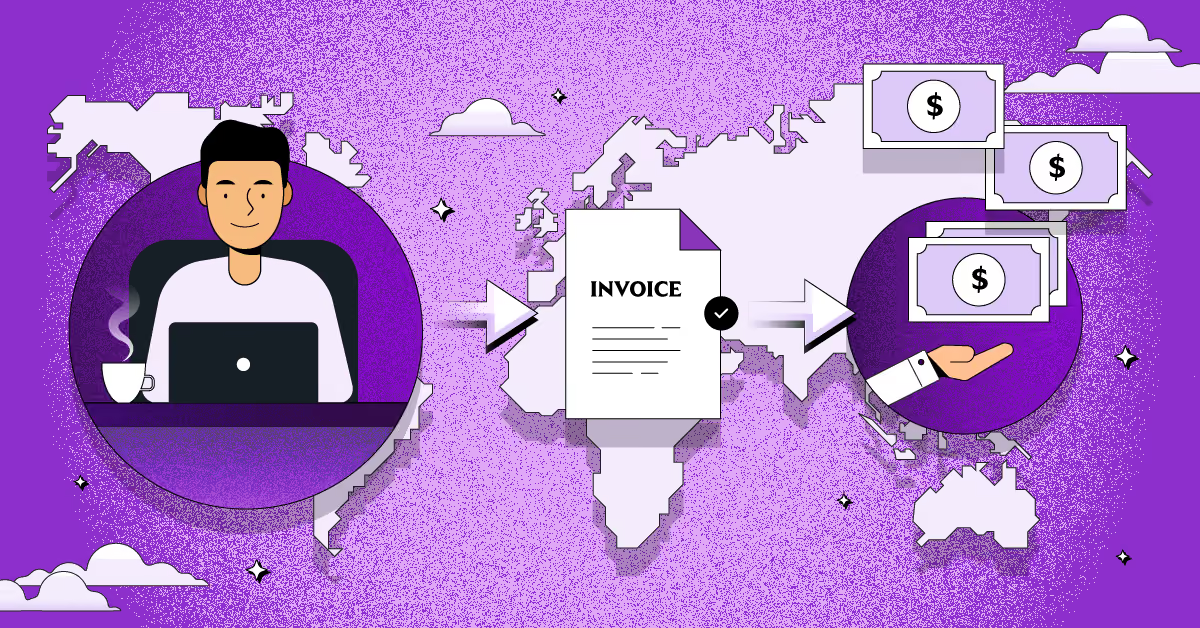
Paying an influencer sounds simple. You find an influence, agree to a rate, they post, and you send the money.
Easy, right?
Well, until you find out…
- The creator's talent agency signs the contract but the creator is the one who needs insurance.
- The free product you shipped to 200 nano-creators counts as taxable income
- Your best creator is still waiting on an invoice from a campaign that finished months ago
- The fee covers one post but your paid media team has been running it as an ad for six weeks
Influencer spending has scaled faster than the infrastructure for paying it. IAB forecasts US creator ad spend will reach $44 billion in 2026 (up from roughly $37 billion in 2025), growing at nearly four times the rate of the wider media industry.
But the payment and compliance layer underneath haven’t kept pace. Fortunately, you can take steps to improve your infrastructure and compliant pay influencers at any scale.
Key Takeaways
- Influencer engagements break standard contractor workflows because the entity signing the contract is often not the person doing the work.
- Gifted product is taxable compensation. Roughly 71% of creators don't know this, which pushes the reporting burden onto brands.
- The 1099-NEC threshold rose from $600 to $2,000 for tax year 2026, but FTC disclosure obligations have no dollar threshold.
- Payment speed is a competitive advantage in a market where creators routinely wait 30 to 120 days to get paid.
Influencer Payments Don’t Work with Standard Workflows
Most contractor management assumes a one-to-one relationship. You engage a person, that person signs, that person invoices, and that person gets paid.
Influencer programs don’t work that way, though:
- The signer and the worker are often different parties. A talent agency or management company frequently holds the contract while the individual creator is the one producing content and carrying insurance. That parent-child structure breaks contract templates built for a standard engagement, because the entity you're contracting with isn't the entity performing.
- Payment routing changes per deal. Sometimes you're paying the creator directly. Sometimes their agency, which then pays them. Sometimes a specialist intermediary sits between both. Each route has different tax documentation requirements and different reporting obligations.
- Compensation isn't only cash. Product, trips, event access, affiliate commission, and usage rights fees all carry value, and several of them carry tax consequences.
- Volume is lopsided. A single campaign might involve three macro creators on negotiated contracts and 300 nano creators receiving product. Both populations create obligations.
Most companies assume influencer engagements are lighter-touch than other contractor work, but in practice, that’s not the case. Influencer engagements are heavier because a standard IC agreement doesn't cover usage rights, exclusivity, disclosure obligations, or a contracting structure with two parties on the talent side.
7 Non-Negotiable Parts of Your Influencer Contract
A creator agreement has to do more work than a typical contractor agreement. These are non-negotiable terms you need to include (at a minimum):
- Deliverables. Platform, format, quantity, and posting window. Leave nothing to chance or ambiguity.
- Usage rights. Define the channels, the duration, and the territories, and pay for them explicitly. A creator's fee for organic posting is not the same as the right to run that content as paid media, use it on your website, or repurpose it in perpetuity.
- Whitelisting and paid amplification terms. If you'll be running ads through the creator's handle, that's a grant requiring its own compensation and defined terms.
- Exclusivity. Category exclusivity is reasonable and common. Broad exclusivity is expensive and, if it functionally prevents the creator from working with other clients, it starts to look like an employment relationship rather than an independent one.
- FTC disclosure obligations. Require clear and conspicuous disclosure on every piece of content, name the format, and reserve the right to require correction. The FTC's civil penalties for deceptive endorsements reach up to $53,088 per violation in 2026, and they apply per non-compliant post.
- Content approval and revision limits. How many rounds, what the turnaround is, and what happens if approval stalls.
- Payment terms with a defined date. Name what triggers payment and when it lands. Be precise.
Are Influencers Independent Contractors?
Yes, most of the time. A creator producing content on their own equipment, schedule, and with their own audience is usually an independent contractor status under the IRS three-category common law test. They control the means and methods, bear their own business risk, and serve many clients.
Where it gets complicated:
- Long-term ambassador arrangements with broad exclusivity, required posting cadence, and brand-directed content start to erode independence. The more your direction resembles managing an employee, the weaker the classification position.
- Creators working on-site at brand events or in studio may need different treatment than remote content production, particularly around insurance.
- International creators are classified under the law of the country where the work is performed. A creator in Germany or Spain is assessed under local rules regardless of where your brand sits.
That’s why you need to run classification per engagement rather than assuming the category is safe. It usually is, but documenting why is what protects you when a long-running ambassador deal gets questioned later.
The Gifting Trap with Influencers
Gifted product sent in exchange for content is taxable compensation. You don’t mark it as a marketing expense.
IRC Section 61 defines gross income as income from any source, and Treasury regulations specify that includes income realized in any form, whether money, property, or services. The narrow gift exclusion under Section 102 rarely applies because a brand sending product in hope of a post isn't acting from disinterested generosity.
Here’s what you need to know:
- Value is measured at retail. The fair market value is what a customer would pay, so you can’t use wholesale prices. Programs that report at cost systematically under-report.
- It counts toward reporting thresholds. Cash, gift cards, and product value aggregate together toward the same 1099 threshold for a single creator in a calendar year.
- Most creators have no idea. Around 71% of creators don't realize free products and brand trips count as taxable income, which pushes the tracking and reporting burden onto the brands paying them.
If you ship products to hundreds of nano creators, a meaningful share may cross reporting thresholds without anyone tracking cumulative value per person. The IRS matching system cross-references what brands deduct as business expense against what creators report as income, and mismatches surface automatically.
Influencer Tax Documentation and Reporting
Domestic creators submit a W-9 before payment. For tax year 2026, the 1099-NEC reporting threshold rose from $600 to $2,000 under the One Big Beautiful Bill Act, applying to payments made after December 31, 2025. Payments made during 2025 still use the $600 threshold on forms filed in early 2027. From 2027 the threshold is indexed to inflation.
This ultimately reduces the number of forms you file, but it doesn't reduce the need for accurate cumulative payment records per creator. That’s because you still need to know who crosses $2,000 in the first place, and multiple small payments plus product value add up.
International creators submit a W-8BEN if they're individuals, or a W-8BEN-E if they're a business entity, before the first payment. Without valid documentation, the IRS requires 30% withholding on applicable US-source payments. That source is determined by where the work is performed, so a creator producing content entirely outside the US generally earns foreign-source income.
The EU adds DAC7. Influencer management platforms facilitating creator payments must report earnings directly to national tax authorities, which then share data across member states. 2026 is the first full enforcement year following the soft launch.
Germany adds one more. The Künstlersozialabgabe, Germany's artists' social contribution levy, sits at 4.9% for 2026 and now applies to single cross-border creator hires. It catches brands that assume engaging a German creator carries no local obligation.
Global Influencer Payouts: Speed Is the Ultimate Differentiator
The creator economy has a payment problem, and it's an opportunity for brands willing to fix it.
- Creators routinely wait 30 to 120 days to be paid
- More than half of creators earn under $15,000 a year
- The top 10% capture 62% of all brand payments
- Creators lose 15.3% to self-employment tax before income tax
- Creators are advised to set aside 25 to 30% of every payment
Now you can see how inconvenient (and sometimes impossible) a 90-day payment cycle can be.
The brands that pay reliably and quickly get first look at inventory, better rates, and repeat partnerships. It's the cheapest competitive advantage available in creator marketing, and most brands don't take it.
Operationally, that means:
- Local currency payouts through methods that work in the creator's market
- Payment status visible to both sides, so nobody has to email asking where their money is
- Invoice validation against the agreement, so a fee that doesn't match the contract surfaces before approval rather than after
- Tax documentation collected at onboarding, so nobody is unpayable after they've already delivered
How Worksuite Handles Influencer Payments
Worksuite manages influencer and creator programs alongside the rest of a contingent workforce, which matters because most brands run both (and shouldn't run them in separate systems).
The parent-child structure is handled natively. Where a talent agency holds the contract and the individual creator performs and carries insurance, both relationships live on the record with the right documentation attached to each. Payment routes to the correct party, whether that's the creator directly, their agency, or an intermediary, without anyone rebuilding the workflow per deal.
- Contract templates are configurable per engagement type, so an ambassador agreement, a one-off post, a whitelisting deal, and a gifting arrangement can each carry their own approved terms and their own approval routing. Legal approves once, and every agreement issued inherits the language.
- Classification runs before contracts are signed, against the applicable federal, state, and local tests across all 50 US states and 190+ countries, backed by indemnification.
- For on-site creator work at events or shoots, per-gig insurance can be issued in the creator's own name through a 1099Policy integration.
- Tax documentation is collected during onboarding, with W-9s, W-8BENs, and W-8BEN-Es routed automatically based on the creator's location and entity type.
- Global Pay processes payments in 190+ countries and 120+ currencies, with 1099 filing handled at year end and payment status visible to both your team and the creator.
Book a live demo to see how Worksuite manages creator contracts, compliance, and payouts.

FAQ
How do you pay influencers?
Through a contract that specifies deliverables, usage rights, and payment terms, followed by an invoice validated against that agreement and paid in the creator's local currency.
Do brands need to issue 1099s to influencers?
For US creators, yes, once total compensation crosses the reporting threshold in a calendar year. That threshold rose from $600 to $2,000 for tax year 2026 under the One Big Beautiful Bill Act. Importantly, the fair market value of gifted product counts toward that total alongside cash. Worksuite tracks cumulative payments per creator and handles 1099 filing automatically at year end.
Is gifted product taxable for influencers?
Yes, when it's provided in exchange for content. IRC Section 61 treats income realized in any form as gross income, including property, and the gift exclusion rarely applies because the brand expects something in return. Value is measured at retail rather than wholesale.
Are influencers employees or independent contractors?
Almost always independent contractors. They use their own equipment, set their own schedule, work with multiple brands, and control their creative methods, which satisfies the IRS common law test comfortably. The exceptions worth watching are long-term ambassador deals with broad exclusivity and brand-directed content, where independence erodes.
How do you pay international creators?
Collect a W-8BEN from individuals, then pay in local currency through a method that works in their market. Additional obligations may apply locally, including DAC7 reporting across the EU and Germany's Künstlersozialabgabe levy on cross-border creator hires. Worksuite collects the right documentation automatically based on the creator's location and pays in 190+ countries.