
TL;DR: How to navigate Worker Classification in the U.S. in 2026: Understanding the distinction between 1099 independent contractors and W-2 employees is essential for hiring businesses. Proper classification has a direct impact on tax obligations, legal compliance, and workforce management strategy.
Understanding 1099 and W-2 Classifications
In the U.S., workers are typically classified as either:
- 1099 Independent Contractors: Self-employed individuals who provide services to businesses under agreed-upon terms. The designation “1099” refers to the tax form businesses use to report payments made to these contractors.
- W-2 Employees: Individuals employed by a company, which maintains control over their work tasks, schedules, and conditions.. The term “W-2” refers to the tax form employers use to report employee earnings and taxes to the IRS.
In the United States, several agencies provide guidance on proper worker classification, including theInternal Revenue Service (IRS), the Department of Labor (DOL) and individual state agencies. Various tests used to determine classification, depending on the governing agency and jurisdiction.
Key Differences Between 1099 Contractors and W-2 Employees
Aspect
1099 Independent Contractor
W-2 Employee
Employer
Working for themself
Working for someone else’s business
Control Over Work
High autonomy; sets own schedule and methods
Employer assigns the work, dictates schedule, and methods
Tax Responsibilities
Responsible for self-employment taxes; no withholding
Employer withholds income, Social Security, and Medicare taxes
Risk of Profit / Loss
Can increase profit through business decisions
Generally, only earns more by working additional hours
Benefits Eligibility
Not entitled to employer-provided benefits
Eligible for benefits like health insurance and paid leave
Relationship Duration
Temporary relationship until project is completed
Continuing or indefinite relationship with their employer
Equipment or Tools
Typically provides their own tools, equipment, materials
Typically uses the employer’s materials, tools and equipment
Implications of Misclassification
Misclassifying employees as independent contractors can result in:
- Financial Penalties: Misclassification claims can result in significant financial penalties, including back taxes, unpaid wages, interest, and fines from the auditing agency.
- Legal Consequences: The legal consequences can include lawsuits related to wrongful termination, overtime and denied benefits, as well as claims under anti-discrimination and labor laws. Workers may form a class action lawsuit when groups of workers are impacted.
- Reputational Damage: Reputational damage occurs when legal actions, fines, or negative press expose a company’s noncompliance, leading to loss of trust among clients, employees, and the public. This can harm employer branding, hinder recruitment, and impact business partnerships.
- Loss of Productivity: Employment audits focusing on worker classification are time-consuming and resource-intensive. Audit findings often result in an overhaul of company policy and processes.
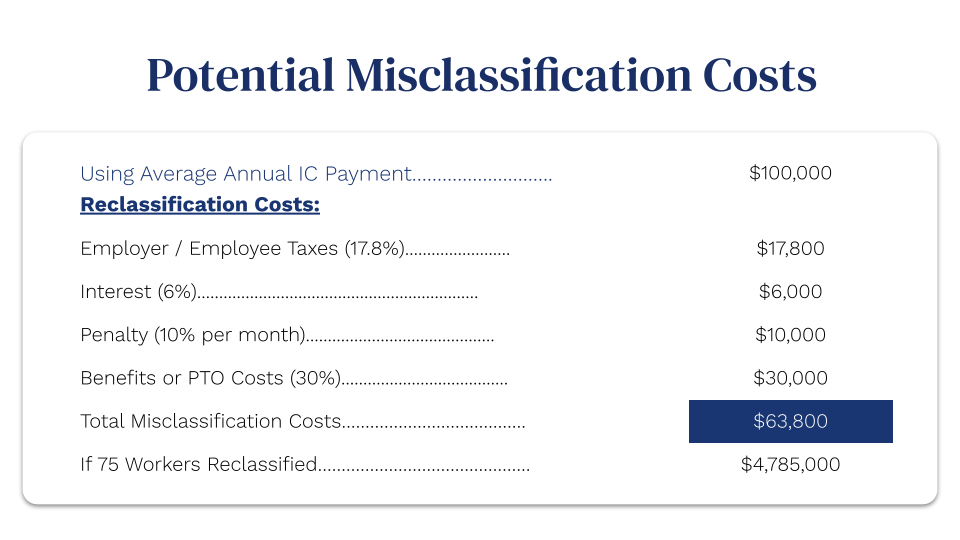
↑ Does not include potential ACA fines, figure is dependent upon total # eligible U.S. workers.
State labor agencies, the IRS and Department of Labor actively investigate misclassification cases, emphasizing the importance of accurate worker classification.
Best Practices for Compliance
- Embed Compliance Screening into Onboarding: : Integrate worker classification checks into the new vendor and contractor onboarding process to ensure proper vetting before work begins.
- Consult Legal Experts: Seek guidance from employment counsel or specialized firms when drafting contracts. State and federal classification tests are complex, often subjective and continually evolving–new laws or interpretations can significantly impact compliance requirements.
- Use Clear Contracts: Define the nature of the working relationship explicitly to ensure the scope of work is well-defined, project-specific, and includes clear acceptance criteria. This not only helps mitigate misclassification risk but ensures alignment on objectives. This reduces the potential for future disputes–especially when contracts are stored in a central repository for easy access.
- Educate Management: Companies should educate hiring managers on their worker classification process and policy to ensure consistent, compliant decision-making during recruitment and engagement. Informed managers are less likely to make missteps that could lead to legal, financial, or reputational risks related to misclassification.
- Partner with Industry Experts for Peace of Mind: Worker classification laws are complex and constantly evolving—making mistakes can be costly. Partnering with an industry expert like Worksuite helps ensure your processes are correct from the start. Our platform automates onboarding, integrates compliance checks, and provides a central repository for contracts. Most importantly, we back up the classifications with indemnification, giving your business added protection and peace of mind.
Properly distinguishing between 1099 contractors and W-2 employees is essential for legal compliance and effective workforce management. By understanding the differences and implementing best practices, businesses can mitigate risks and foster a compliant work environment.
One control tower for every worker type. Worksuite's classification engine returns the answer the facts support, with no thumb on the scale. Genuine contractors run through Agent of Record (AOR), engagements that need employment run through Contingent EOR, and your whole global contingent workforce stays in one system of record.

FAQ
Can a worker be both a 1099 contractor and a W-2 employee for the same company?
Generally, no. A worker should be classified consistently based on the nature of their role and relationship with the company. Issuing both tax forms to the same individual during the same tax year can raise red flags to auditing agencies, signaling that something is amiss.
What form should be used to report payments to a 1099 contractor?
Form 1099-NEC is used to report non-employee compensation to the IRS.
Are there tools to help manage worker classifications?
Yes, platforms like Worksuite offer expert-reviewed solutions, helping businesses apply the applicable classification test and ensure compliance with evolving regulations. These tools automate the compliance workflows, and centralize important documentation. Selecting a platform that includes indemnification—like Worksuite—adds a vital layer of protection, shielding your business from potential legal and financial risks. Don’t leave worker classification to chance.Let Worksuite help you stay compliant, protected, and ahead of the curve. [Book a free compliance consult today →]


