Freelancers can be your fastest path to speed and specialization. But only if your onboarding process does not slow them down.
Too often, companies treat freelancer onboarding as an afterthought. That might work for a single contractor. But as you scale, manage across functions, or operate globally, cracks start to show. And those cracks cost time, trust, and sometimes, compliance.
Here are the top mistakes we see across fast-growing teams — and how to fix them with a system that supports scale, compliance, and speed.
Mistake 1: Treating Freelancers Like Full-Time Employees — or Ignoring Them Entirely
This is the most common early misstep once the freelancer has been onboarded. Some companies go too far, pulling contractors into standups and review chains meant for employees. Others swing the other way, giving freelancers no access, no context, and no clarity.
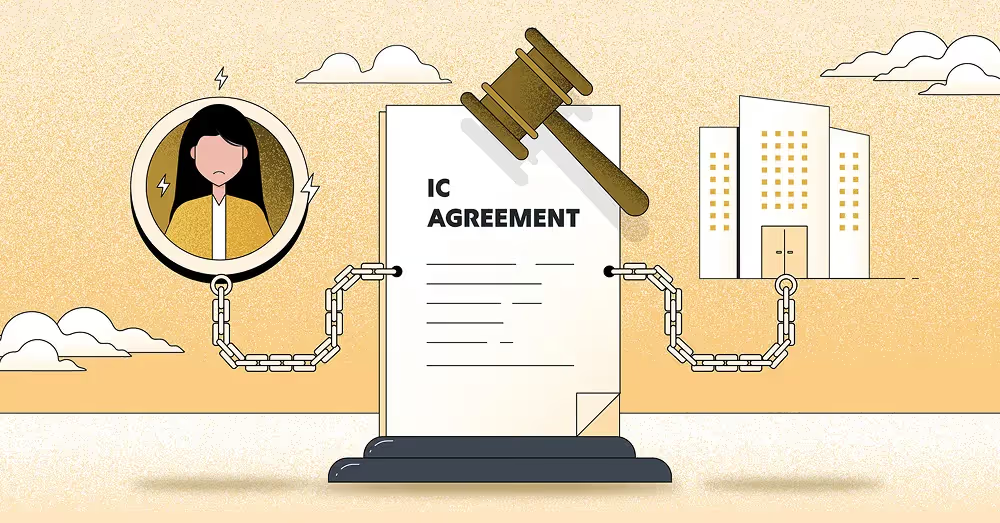
Both approaches fail. The first introduces classification risk - because calling someone a freelancer doesn’t make it so. If you treat a freelancer like an employee (and there are many national/state/local tests for such classification, then you are exposing yourself to a significant risk in terms of fines and benefits owed.
The second approach (keeping the freelancer too far from the efforts) kills productivity. If your freelancer has little platform access, instruction, or people access, then it will be unlikely to achieve key objectives.
What to do instead:
- Trust a Freelancer Management System provider to properly classify your talent
- Define a clear scope of work with outcomes and deadlines
- Assign a single point of contact (with a backup)
- Provide tool access without making them part of every meeting
- Let them operate independently within a structured framework
Worksuite helps teams configure onboarding workflows that create autonomy without ambiguity. Contractors get what they need on Day One, and teams stay within compliance bounds.
Mistake 2: Skipping the Legal and Tax Foundations
This one always shows up later — in finance audits, legal reviews, or delayed payments.
Kicking off work before collecting the essentials is risky. No signed agreement, no tax form, no NDA? That is not just a missing document. It is a compliance liability.
What to do instead:
- Require a signed contract with scope, rate, and IP terms
- Collect a W-9 for U.S. freelancers or a W-8BEN for international ones
- Include NDAs or jurisdiction-specific forms as needed
Worksuite automates this collection. As soon as a freelancer profile is created, the required documents are requested, tracked, and stored in the right format. No email chases. No legal gaps. All easily searchable by anyone with proper credentials, even if someone leaves your team.
Mistake 3: Delaying Access and Setup
This is not a people problem. It’s a process one.
Freelancers should not spend their first day waiting for credentials. Yet many do, because no one owns the setup workflow. The result? Lost hours, missed context, and slower execution.
What to do instead:
- Set up platform access and shared folders before Day One, with automated notifications to key IT resources as new freelancers come onboard
- Issue temporary logins or secure credentials where needed
- Provide relevant onboarding resources upfront
With Worksuite, onboarding workflows trigger IT or team alerts automatically. Tool access is customized by region or role. And everything is logged so you can track progress without follow-up messages. For customers with sizable scale, notifications can trigger automations, thereby automatically provisioning system access in near-real time.
Mistake 4: Leaving Deliverables and Feedback Undefined
Freelancers are not mind readers. Vague directions like "help with the launch" or "revise the layout" create confusion. You will end up with multiple revisions, missed deadlines, or scope creep.
What to do instead:
- Write a simple brief with success criteria
- List deliverables with deadlines
- Assign a reviewer and clarify how feedback happens
- Schedule a kickoff call for more complex work
Worksuite lets teams attach briefs, assign owners, and set review paths during onboarding. Everything lives in one place, and everyone knows what "done" looks like. Communications with freelancers are logged in the system, so all communications can be viewed and actioned by those with secure platform access.
Mistake 5: Failing to Align on Payment Expectations
This is one of the fastest ways to lose a great freelancer. Unclear payment terms create friction. Delays create mistrust. And trust is hard to rebuild.
What to do instead:
- Confirm rate, method, and schedule before the work begins
- Define who approves the invoice and what format is required
- Use a platform that handles multi-country payments and tax compliance
With Worksuite Pay, you send one wire. We handle contractor payments in 190 countries across 120 currencies, with tax documents and audit trails built in. Contractors get paid faster. Finance teams get cleaner books. Everyone wins. And when there is an issue (issues happen) - Worksuite intervenes directly with a freelancer.
What Worksuite Is — and Why It Is Best in Class
Worksuite is a freelancer management platform built for the way modern companies operate. We are not a staffing agency, a gig marketplace, or a bolt-on payments tool. We are the system behind how your company manages contractors at scale.
With Worksuite, you get:
- A centralized talent directory with real-time profiles and documentation
- Customizable onboarding workflows that adapt by country, team, or role
- Confidence the freelancers you are engaging with are compliant
- Contract automation and tax form collection that stays audit ready
- Global payments that are accurate, fast, and compliant
- Visibility dashboards so HR, legal, finance, and operations stay aligned
Worksuite is setting the standard for how enterprises manage freelance programs. From intake request to final invoice, Worksuite delivers an end-to-end system that replaces spreadsheets, manual approvals, and compliance risks with clarity, automation, and scale.
If your current contractor process feels stitched together, you are not alone. Most of our customers come to us after trying to grow with systems that were never designed for contractors. We help them build what works.
Final Thoughts: Build Onboarding Like You Build Systems
Each of these mistakes is solvable. You do not need more manual steps. You need systems that reduce risk, improve experience, and make onboarding repeatable.
That is what Worksuite is built to do. And when onboarding becomes a system, not a scramble, your freelance program becomes a strategic advantage.
Ready to fix your freelancer onboarding process?
Worksuite helps fast-growing teams streamline onboarding, ensure compliance, and pay contractors anywhere — all from one platform. Book a demo today to see how it works in action.