Close-up of a green rotary dial phone with a pink and blue clipboard holding graph paper notes.

Contingent Workforce Management

When your workforce outgrows the spreadsheet.

When you're working at scale, contingent workforce management outpaces the standard playbook. Thousands of contractors. Dozens of brands and entities. Paying talent in multiple currencies and global jurisdictions, each with their own compliance rules.

Worksuite was designed to solve these complex enterprise problems. We work with agency networks, media publishers, and production companies who need to onboard, manage and pay a high volume of contractors, compliantly.

Onboard thousands of workers while you sleep.

Stop re-building onboarding for every entity, brand, or region. Worksuite lets you configure distinct onboarding workflows for each part of your business. Automate document collection, compliance checkpoints, and approvals. So every contractor starts right, and you stay compliant at scale.

Worksuite interface showing brand launch event contract overview with contract summary, tasks, invoicing, budget, and profile details of Jasmine King.

Compliance built-in.
Not bolted on.

Worker misclassification is one of the most significant legal and financial risks facing contingent workforce programs today. Worksuite integrates Agent of Record (AOR) services, classification engine, and pay processing directly into your FMS workflows. So compliance is baked in from the start.

Worksuite dashboard showing contract list and worker compliance check results for Tammy Smith, indicating a low risk outcome and classification completed.

Pay your contractors anywhere in the world.

Pay thousands of contractors in 190+ countries without the operational overhead. Worksuite handles multi-currency payments, consolidated invoicing, local compliance, and audit-readiness. So your finance team isn't drowning in exceptions and admin. High volume is where Worksuite shines.

Worksuite dashboard showing a list of invoices with statuses, invoice IDs, project names, partners, payout methods, and amounts in USD.

Multi-brand operations

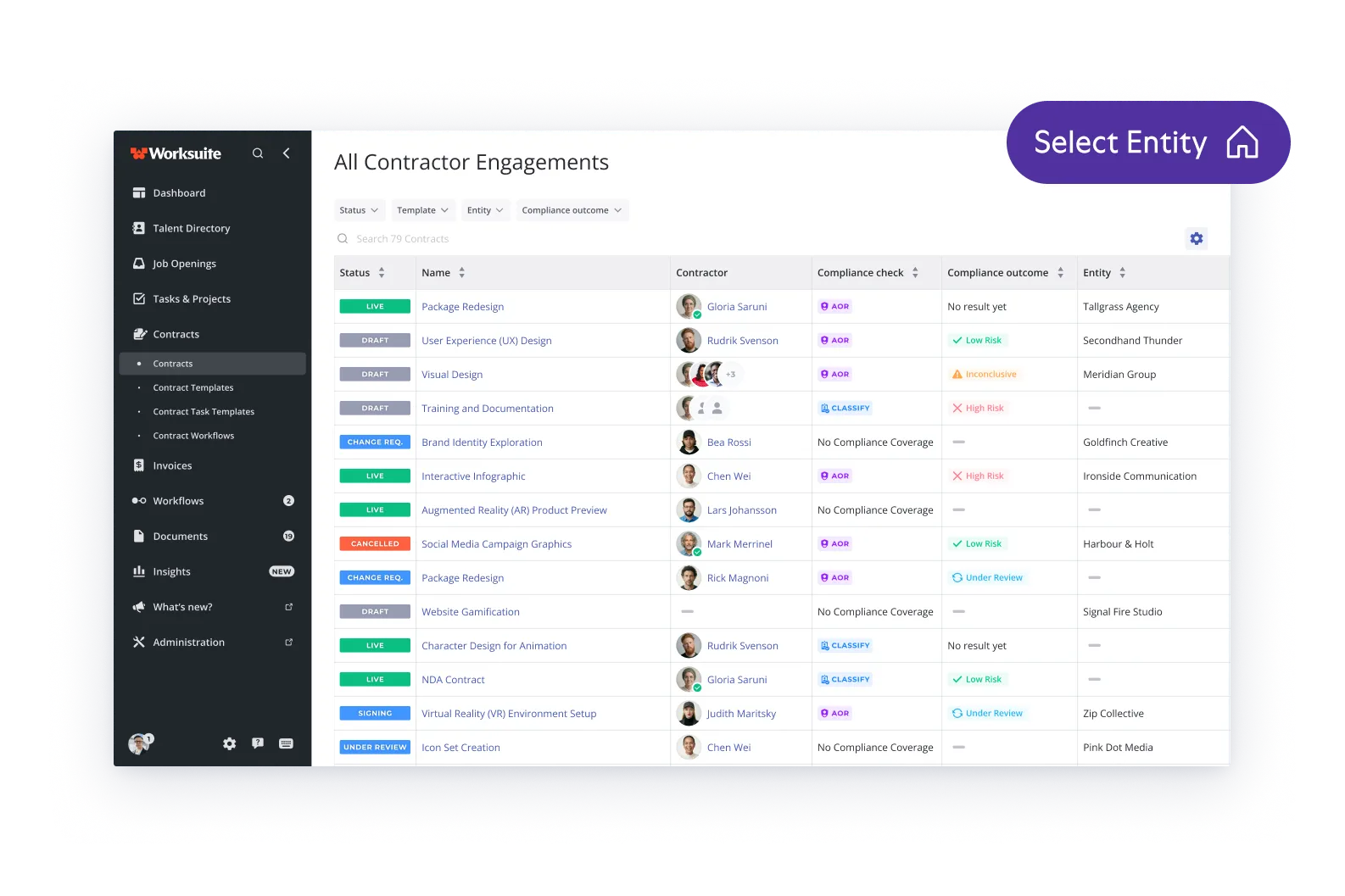
Running resource operations for multiple brands, subsidiaries, or legal entities? Worksuite supports complex organizational structures with configurable entity-level rules, approval hierarchies, and reporting. All in a single platform. Your resource managers, finance and legal teams see only what they need.

Worksuite dashboard showing All Contractor Engagements list with contract status, names, contractors, compliance check, outcomes, and entities.

Take control of global freelancer hiring

Build and own your contingent talent supply. Worksuite's direct sourcing capabilities let you create curated, private talent pools — reducing costs, speeding up time-to-hire, and keeping institutional knowledge inside your program rather than a public marketplace that competitors can poach.

User interface displaying a searchable talent pool with profiles of freelancers and workers including photos, names, companies, and contact icons.

Customize your workflows

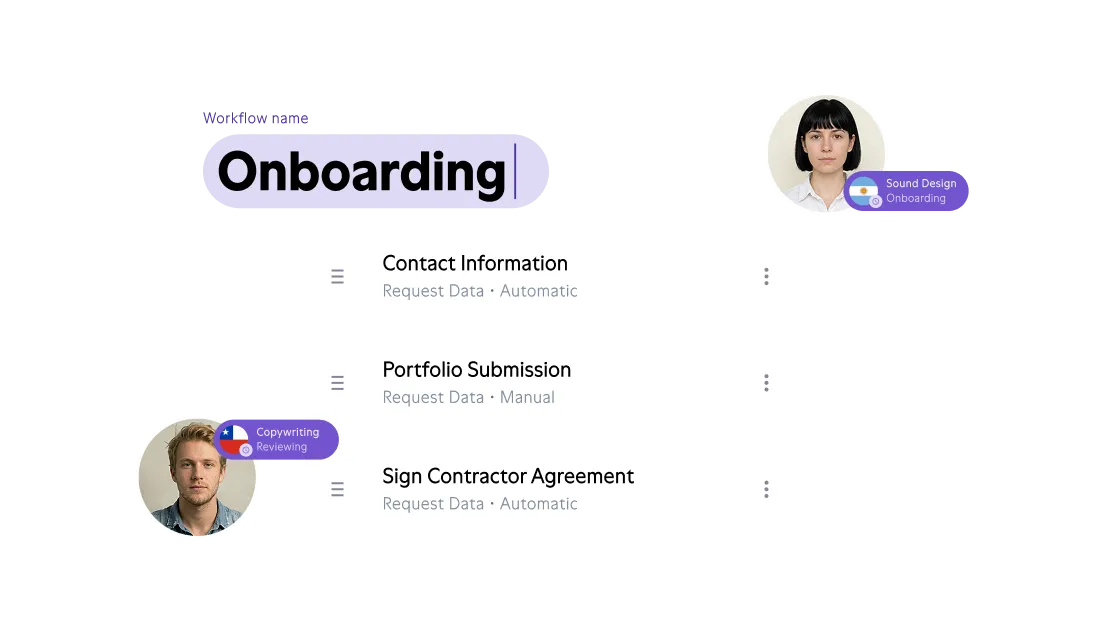
No two contingent workforce programs operate the same way. Worksuite's workflow builder lets your team configure review & approval notifications, compliance gates, and automation rules that match your organizational structure. Not an off-the-shelf template that you have to work around.

User interface showing an onboarding workflow with steps: Contact Information, Portfolio Submission, and Sign Contractor Agreement, each with request types and automation status, alongside profile pictures labeled Sound Design Onboarding and Copywriting Reviewing.

Reporting & analytics

Get the visibility your program deserves. Track contractor spend, headcount, compliance status, and time-to-onboard, and operational efficiency across every entity and region in real time. Worksuite's business intelligence dashboard is designed for enterprise organizations with detailed reporting needs.

Worksuite dashboard showing insights with green bars for time to hire, a US map with shaded states, numeric metrics, a purple pie chart for contractor onboarding status, and a red bar chart for invoices paid under contracts.

Full contract lifecycle management

Manage contingent worker contracts end-to-end: creation, negotiation, signatures, renewal triggers, and expiry alerts. All integrated into the same platform where you onboard, pay, and manage — so nothing falls through the cracks.

Diagram showing contract lifecycle management with a draft contract, two signed profiles, live work folder, and a renewal button with five-star rating connected by arrows.

Project & milestone tracking

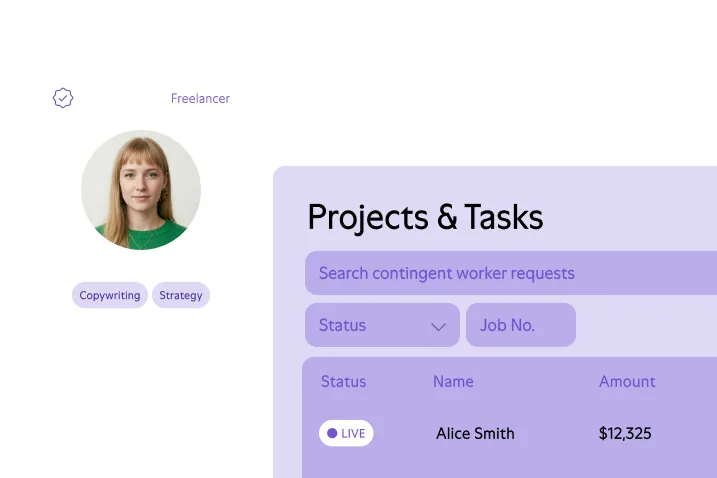
Assign work, track deliverables, and monitor project progress without switching between tools. Built for contingent programs where accountability and visibility matter as much as speed.

Freelancer profile with photo of a woman and tags 'Copywriting' and 'Strategy' next to a Projects & Tasks panel showing a search bar, filters for Status and Job No., and a list with Alice Smith marked as live with amount $12,325.

The Worksuite difference:
human expertise.

Every platform will tell you they're AI-powered. But automation is only as good as the compliance expertise behind it.

Enterprise contingent workforce management requires a human touch. Edge cases, legal complexity, and international compliance requirements that don't fit a dropdown menu.

Worksuite's Solution Engineers specialize in simplifying complex workforce programs. We collaborate with your team and configure the platform to fit the way your business actually works.

Our customer success stories

“The customer experience from the team at Worksuite has been remarkable. They make us feel like we’re the most important client they have. It’s a great product, with great service.”

Allen Larson
VP of Talent Acquisition and Resource Director, Jack Morton
Middle-aged man with short gray hair and glasses wearing a light blue button-up shirt, standing outdoors on a city street.

FAQ

Contingent Workforce Management (CWM) refers to the program-level strategy and operational infrastructure for managing all non-employee workers — freelancers, independent contractors, agency temps, statement-of-work providers, and other flexible talent — as a unified population. A Freelancer Management System (FMS) focuses on the direct contractor relationship: onboarding, compliance, assignments, and payments for workers your company sources and manages itself. A Vendor Management System (VMS) manages the flow of agency-sourced workers through a supplier network. CWM is the umbrella — a mature CWM program typically combines FMS functionality for direct talent, VMS functionality for agency supply, and program-level governance tools for consolidated reporting, spend analytics, and compliance oversight across the full contingent population.

A mature CWM program covers: 1099 independent contractors (managed through direct engagement or AOR), W-2 workers (managed through EOR or direct employment), agency-placed temporary workers (managed through VMS-style supplier workflows), statement-of-work contractors (managed at the project or deliverable level rather than by hours), and in some cases, platform-sourced talent from marketplaces like Upwork or Fiverr that flows into a centralized system for compliance and payment. The critical program design decision is whether each worker type is onboarded into the same compliance and payment infrastructure or managed in parallel systems — parallel systems are the primary source of spend leakage and compliance exposure.

Yes. Enterprise CWM programs frequently operate across multiple legal entities, brands, or business units — each with its own onboarding requirements, contract templates, approval chains, and reporting needs. A properly configured platform supports entity-level separation for compliance and financial reporting while sharing the same talent pool across entities where appropriate. Role-based access controls ensure that a resource manager in one business unit can only see and engage workers within their scope, while program leadership and finance have cross-entity visibility.

Program-level reporting covers contractor headcount by status and classification, total contingent spend by entity, project, and cost center, engagement pipeline (upcoming start dates, expiring contracts, open requisitions), compliance status by worker and jurisdiction, and payment cycle summaries. Advanced analytics layer in tenure concentration risk (identifying workers approaching the tenure thresholds that elevate misclassification exposure), spend mix (direct versus agency versus marketplace), and utilization by skill category. Integration with BI tools — Tableau, Power BI, Looker — allows this data to flow into existing executive dashboards.

Individual-level compliance — classification, document collection, contract execution — is necessary but not sufficient. Program-level compliance means applying consistent rules across the population and enforcing them through automated workflows rather than manual review. Practically, this means: insurance expiration tracking with automated re-verification triggers, classification review cycles for long-tenured contractors (a worker engaged for 18+ months may face elevated scrutiny under IRS common law tests and DOL guidance), jurisdiction-specific rule enforcement updated as regulations change (AB5 amendments, IR35 reforms, EU Directive updates), and audit trail completeness so that if a regulatory body requests records, the program can produce them programmatically.

Yes. Integration with Workday, SAP SuccessFactors, Oracle HCM, and Bullhorn is standard for enterprise CWM programs. These integrations handle bidirectional data exchange: headcount data flows into your HRIS for total workforce visibility, spend data flows into SAP or Oracle for procurement reporting, and new requisitions can originate in Workday and route into the CWM platform for fulfillment. For procurement-specific workflows, integration with Coupa, Ariba, or Jaggaer enables purchase order creation and three-way matching on SOW contracts.

Implementation scope depends on program complexity, but most enterprise CWM deployments follow a phased approach. Phase one establishes the core infrastructure: worker classification framework, onboarding workflows, contract templates, and payment configuration for the primary worker population. Phase two layers in adjacent populations — agency workers, SOW contractors, international workers — and connects integrations to HRIS and accounting systems. Phase three activates analytics, custom reporting, and program governance workflows. Unlike plug-and-play software deployments, a CWM implementation requires co-design between your program team and the platform's solutions engineers to configure classification rules, approval hierarchies, and compliance logic for your specific workforce composition and jurisdictional exposure.

Let’s build your custom contingent workforce program.

Share your challenges and priorities. From there, we’ll design a personalized demo that highlights exactly how our platform can deliver results for your business.

Thanks for submitting the form.